
– David Hawkins, The Eye of the I: From Which Nothing is Hidden
“Take this whole life as a myth, as a story. It is one, but once you take it this way you will not be unhappy. Unhappiness comes out of too much seriousness. Try for seven days; for seven days remember only one thing – that the whole world is just a drama – and you will not be the same again. Just for seven days! You are not going to lose much because you don’t have anything to lose.
“You can try it. For seven days take everything as a drama, just as a show.
“These seven days will give you many glimpses of your buddha nature, of your inner purity. And once you have the glimpse you cannot be the same again. You will be happy, and you cannot conceive of what type of happiness can happen to you because you have not known any happiness. You have known only degrees of unhappiness: sometimes you were more unhappy, sometimes less unhappy, and when you were less unhappy you called it happiness.
“You don’t know what happiness is because you cannot know. When you have a concept of the world in which you are taking it very seriously, you cannot know what happiness is. Happiness happens only when you are grounded in this attitude, that the world is just a play.


The Book of Love and Creation simultaneously helps readers develop as spiritual beings within, while growing into increasingly capable, resilient, and confident individuals amid the demands of outer life. Filled with meditations, exercises, psychological insights, and affirmations, The Book of Love and Creation immediately produces change in the life of every dedicated person who approaches it. Perfect for returning readers and newcomers alike, the book is an extraordinary experience in a new body of channeled wisdom that is attracting readers across the world.
Once a frog from the ocean came and jumped into a well. He got acquainted with the frog in the well and the well frog asked, ‘From where do you come?’ He said, ‘I have come from the ocean.’ The well frog asked, ‘Is it bigger than this well?’ Of course suspicion was in his eyes, doubt in his mind, ‘How can anything be bigger than this well where I live?’ The ocean frog laughed and said, ‘It is very difficult to say anything because there is no measure.’ The well frog said, ‘Then I will give you some measure so that you can.’ He jumped one quarter of the well, one fourth of the way across, and said, ‘Is it that big?’ The ocean frog laughed and said, ‘No.’ So he jumped half of the well, and said, ‘Is it that big?’ Again the ocean frog laughed and said, ‘No.’ Then he jumped three quarters and said, ‘Is it that big?’ Again the ocean frog said, ‘No.’ Then he jumped the whole well, the whole length, and said, ‘Now – now you cannot say no.’ The ocean frog said, ‘You may feel hurt, and I don’t want to be offensive, but still the answer is no.’ Then the well frog said, ‘Get out from here, you liar. Nothing can be bigger than this well!’

“So please understand from the start, when I’m talking to you, I’m not trying to convert you. I’m not trying to do you any good. I’m just doing my own stuff. I talk this way like birds sing. It amuses me. I enjoy it because I’m interested. I’m full of wonder about this universe. Full of all sorts of thoughts about it and I like to share these with people not in order to interfere with your personal lives or make you dependent on me, heaven forbid. If I had enough people dependent on me I would have no sleep at nights at all, it would be on the phone, be hanging around as I go away. But simply that I think that with our exchange of ideas and rubbing ourselves against each other we may find something of mutual interest. And let’s not make any more ambitious claim for it than that. Because anything beyond that would be getting us into the world of power games. Trying to influence people, trying to control people and I’m not interested in that.”
Alan Watts, ‘Worldly Religions’
Not that which the eye can see, but that whereby the eye can see: know that to be Brahman the eternal, and not what people here adore;
Not that which the ear can hear, but that whereby the ear can hear: know that to be Brahman the eternal, and not what people here adore;
Not that which speech can illuminate, but that by which speech can be illuminated: know that to be Brahman the eternal, and not what people here adore;
Not that which the mind can think, but that whereby the mind can think: know that to be Brahman the eternal, and not what people here adore.
Kena Upanishad

“It seems a farmer was out working his field when his plow caught on something, and it wouldn’t budge. The horse reared up and the farmer cursed. After calming the horse the farmer yanked back on the braces. But the plow still wouldn’t budge. Because he was an impatient man his first reaction was to go into Judger. Had a rock or other obstacle broken his plowshare? That could mean losing at least two days’ work while he hauled the broken parts to the blacksmith! Cursing, he began digging around to free the plow. To his surprise, he discovered that it was caught on an iron ring buried six inches under the ground. After freeing his plow, the farmer got curious. He cleared away some of the dirt and pulled on the iron ring. Off came the lid of an ancient chest. He peeked down inside it. Before him, glittering in the sun, lay a treasure of precious jewels and gold.

This story reminds us that it is often by confronting our toughest obstacles that we find our greatest strengths and possibilities, but sometimes we’ve got to dig deep to find them. Campbell had a phrase for it: Where you stumble, there your treasure is.
To uncover that treasure you’d ask yourself questions like: What could I discover? What haven’t I noticed before? What might be valuable here?”
Change Your Questions, Change Your Life: 12 Powerful Tools for Leadership, Coaching, and Life by Marilee Adams and Marshall Goldsmith
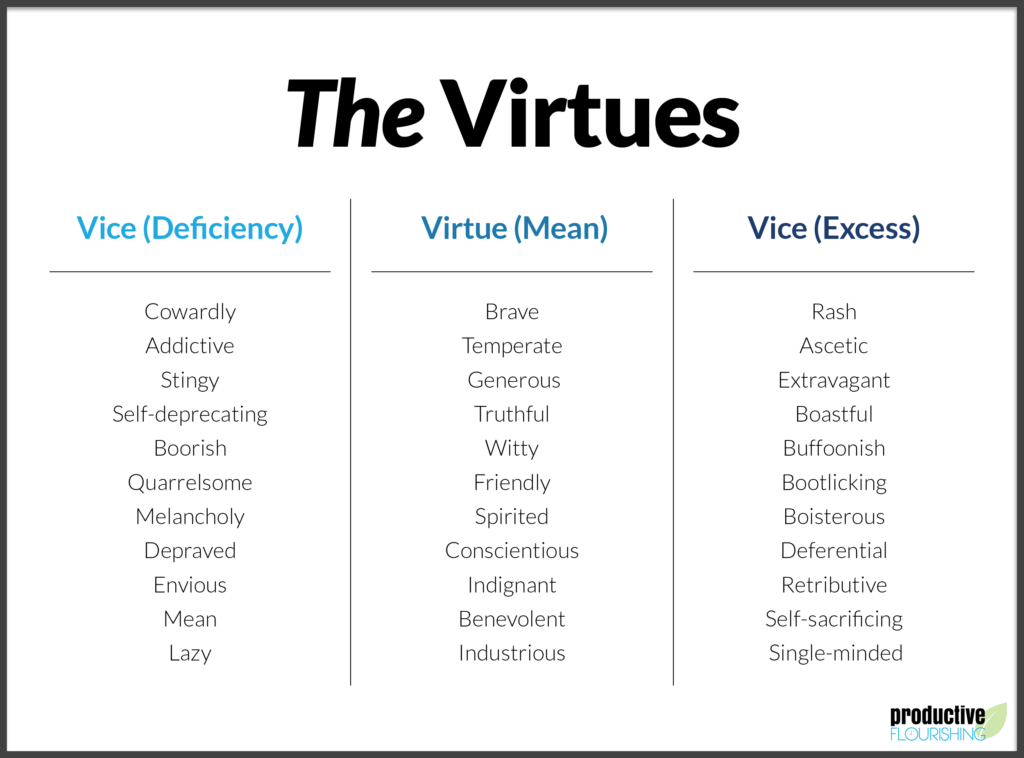
Aristotle’s 12 virtues are a great checklist to understand the different morals, values, and virtues that you could cultivate or restrain in your life. It’s like an ancient Greek personality test.
Moderation in all things, including moderation: Aristotle was clear that too much (excess) of any virtue is just as bad as lack (deficiency). You must find the mean, the right balance.
 ONE TUSK