
Thought of the Week – 26th October 2026 (2)


Most lives don’t change because of talent alone. They change because someone noticed.
Sir Ken Robinson, the educator whose 2006 TED talk “Do Schools Kill Creativity?” became one of the most watched ever, often said that what makes the difference isn’t brilliance. It’s encouragement.
And encouragement only ever comes from one place: another person.
Robinson’s favourite example was Gillian Lynne. In the 1930s she was the girl who couldn’t sit still. Her school thought she might have a learning disorder, and her mother took her to a specialist.
The doctor listened. Then he asked for a private word with her mother, switched on the radio as they left, and watched Gillian through the window. Within moments she was on her feet, moving to the music.
“Mrs Lynne, Gillian isn’t sick. She’s a dancer. Take her to a dance school.”
Everyone around Gillian had seen the same restless girl. Only one person really looked. She went on to the Royal Ballet, and later choreographed Cats and The Phantom of the Opera.
The talent was always hers. The turning point was being noticed.
Systems sort. They measure, rank and label. Relationships do something different. They see.
Someone who knows you can spot what others might dismiss as a distraction, a quirk, or “that thing you should probably stop doing”, and recognise it as a signal.
So often, the people around us are too busy, too tired or too focused on the next deadline to notice. They quietly say: focus on your homework, stop that, this is what matters now.
But sometimes, one person, a parent, a teacher, a mentor, stops long enough to see. And says: yes, keep going.
This isn’t just a nice story. Again and again, people who study human growth arrive at the same place:
Different fields, same message: potential grows in relationship. Someone has to see it first.
Continue reading
The thing exhausting you may not be your workload, your family or your boss. It may be the belief that it all depends on you.
That’s the idea behind a line from the Ashtavakra Gita, an ancient Indian text:
“You have been bitten by the deadly black serpent of the ego and you therefore consider yourself as the doer. Drink the nectar of the faith that you are not the doer and be happy.”
Ouch. But think about it for a second.
Most of us walk around with a quiet belief: I am the one making everything happen, so I’m the one to blame (or praise) for how it all turns out.
That belief is exhausting. It’s why you replay that awkward meeting at 2am. It’s why a bad review ruins your week. It’s why you grip your kids’ choices, your career, your relationships and your reputation like a drowning person gripping a rope.
That grip is attachment. And the strange part is that we’re rarely attached to the thing itself. We’re attached to what it says about us.
Almost every wisdom tradition has spotted the same trap:
Different centuries and cultures, same message: you are less in control than you think, and that’s good news.
In Letting Go, psychiatrist David Hawkins says we don’t suffer because of events. We suffer because of the feelings we stuff down, fight or lash out with. Underneath those feelings, he says, are three big wants:
His fix is refreshingly simple. When a feeling shows up, don’t fix it, blame anyone or push it away. Just feel it, fully, until it passes. Then ask: Could I let go of the wanting?
This is where people get nervous. If I’m not the doer, why bother?
You bother because letting go is not giving up. The Bhagavad Gita says to act fully but release your grip on the results. Do the work, love hard, show up, and stop demanding a guaranteed payoff.
And here’s the surprise: you usually perform better. Think of a tennis player choking on match point versus one who’s relaxed and in the zone. Fear of failing makes you clumsy. Let go of the outcome and you free up your energy for the task.
Letting go is also not the same as detaching from people. You can love someone deeply without needing them to behave a certain way so you can feel okay.
The serpent’s venom says: everything depends on you.
The nectar says: you’re part of something bigger. Do your part, and let the rest go.
Attachment is a clenched fist. Letting go is an open hand. It can still hold things, but it doesn’t have to in order to be okay.
You don’t need to rewire your whole life. Pick one thing you’ve been gripping this week, a deadline, a person, an opinion of you, and ask: Is this really mine to control? Then unclench, just a little.
-One Tusk supported by Claude
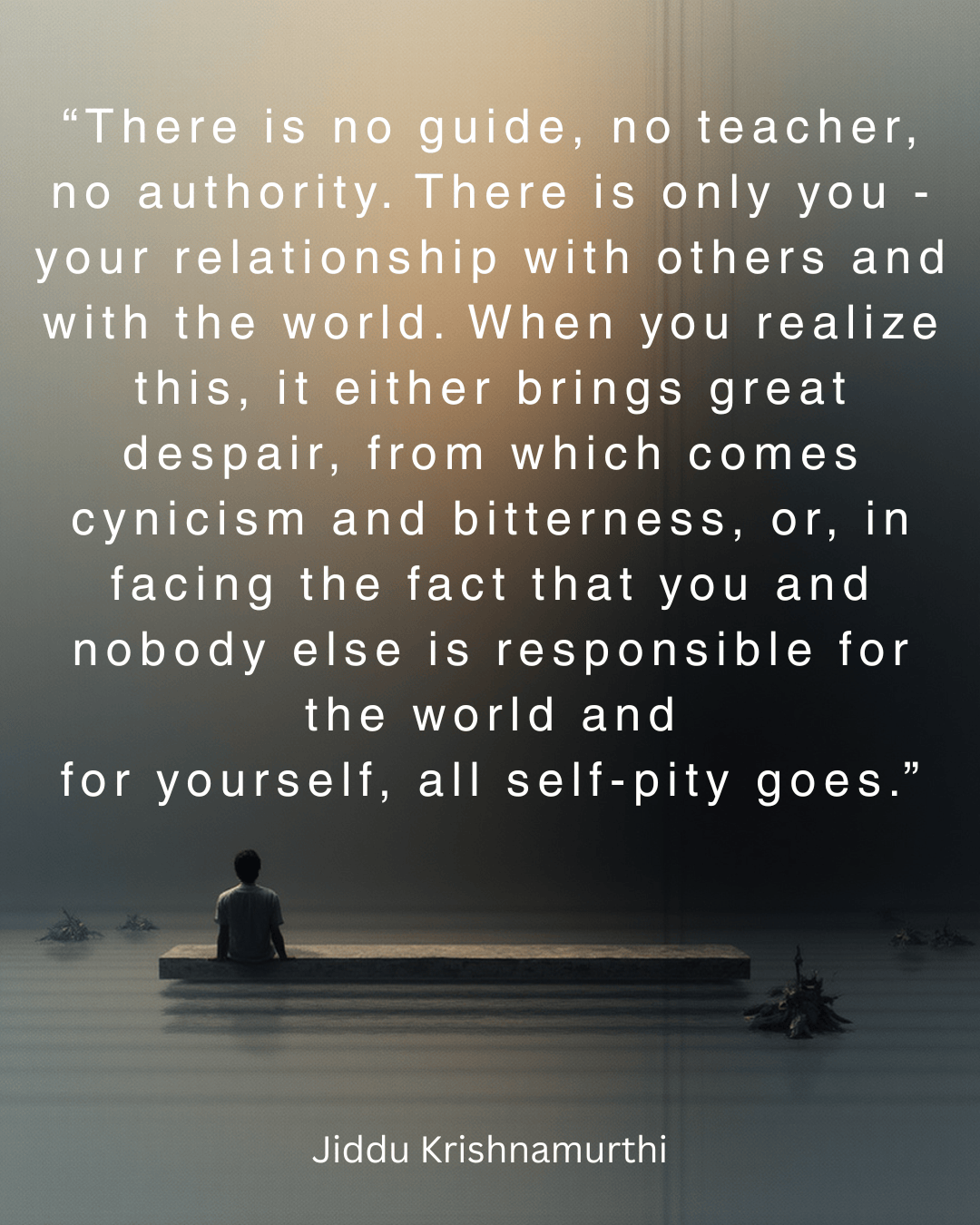


“Understanding brings silence, not speech”
It sounds backwards. Yet think of the wisest people you’ve known. Often they were the quietest in the room.
When we half-understand something, we explain, argue and repeat. Much of that talk is for us: proof that we know. Real understanding settles that restlessness. There’s nothing left to prove.
Grief. Love. Awe. Anyone who has truly lived them knows that words fall short. Saying more would only make them smaller.
Even everyday things escape us. The philosopher Ludwig Wittgenstein once asked: “Describe the aroma of coffee. Why can’t it be done? Do we lack the words?”
Try it. Rich, warm, bitter, earthy… Every word circles the smell, but none of them is it. Yet you know that aroma instantly, the moment it reaches you. We can know something deeply and still be unable to say it.
When someone shares their pain, we rush to fix it. Understanding doesn’t rush. It listens. It stays.
“Those who know do not speak; those who speak do not know.” So says the Tao Te Ching. Zen teachers and Christian mystics say the same.
Centuries later, Wittgenstein arrived at the same place: “Whereof one cannot speak, thereof one must be silent.” Across ages and traditions, the deepest truths are met in stillness.
The next time you feel the urge to explain, correct or win, pause for one breath and ask:
Have I really understood yet?
That quiet isn’t empty. It’s full: settled, attentive and at peace.
-One Tusk supported by Claude

The path to wisdom, I have found, asks three things of us: silence, humility and suffering. Deepak Chopra arrives at the same three in his new book, Awakening in the Final Chapter, where wisdom is one of six qualities he sees deepening in life’s later years. Silence makes room to listen, humility reminds us there is always more to understand, and suffering, if we let it teach us, shows us something of ourselves (Chopra, 2026).
Not the absence of sound, but the willingness to stop the inner commentary of opinions, judgments and plans. Meditation trains exactly this: returning, again and again, to the still point beneath the chatter (Kabat-Zinn, 1994). In that stillness a luminous receptivity opens, and we begin to hear what the busy mind would miss.
Not performed modesty, but the honest recognition that the unknown vastly exceeds the known and every perspective is partial. The Vedantic neti, neti (“not this, not this”) warns us never to mistake a concept for the reality it points to (Brihadaranyaka Upanishad 2.3.6). The map is not the territory (Korzybski, 1933); the finger pointing at the moon is not the moon.
The Tamil poet Avvaiyar put it more simply still:
கற்றது கைம்மண் அளவு, கல்லாதது உலகளவு
Kattrathu kaimman alavu, kallathathu ulagalavu
What we have learned is a handful of sand; what we have yet to learn is the size of the world.
Not because pain is noble in itself; it is not. But loss, failure, illness and betrayal, if we don’t harden against them, can crack the persona and show us what is real.
Viktor Frankl, writing after the concentration camps, observed that when we can no longer change a situation, we are challenged to change ourselves (Frankl, 1946). Modern psychology has given this a name: post-traumatic growth, the positive change many people report after profound struggle (Tedeschi & Calhoun, 2004).
Suffering teaches us, at a level deeper than the intellect, that we are more than our circumstances, and more than our stories about our circumstances.
Silence lets us hear, humility lets us admit we have not yet understood, and suffering, met with an open heart, breaks the shell that keeps both out. Wisdom is less something we acquire than something we make room for.
–One Tusk supported by Claude
“Useless nourishment is not only what you eat. Every meaningless word, opinion, and impression you consume feeds the mind. Ashtavakra calls you to drop this burden. When the unnecessary ends, revolution begins within.”

We are so careful about what we put into our bodies. Yet from the moment we wake, we feed our minds a steady diet of news, notifications, opinions and other people’s noise, and we rarely stop to ask whether any of it actually nourishes us.
The Chandogya Upanishad (7.26.2) teaches that pure food leads to a pure mind. The Sanskrit word for food, āhāra, simply means ‘that which is taken in’, and Adi Shankara reminds us this includes everything we see and hear. In other words, the headline that unsettled us and the careless comment we keep replaying are all meals we have eaten, whether we meant to or not.
What we don’t need doesn’t disappear. Words keep echoing, borrowed opinions start to feel like our own, and the mind grows so restless that the moment things go quiet, we reach for our phones.
The sage Ashtavakra, teaching King Janaka, puts it simply: “If one thinks of oneself as free, one is free, and if one thinks of oneself as bound, one is bound” (Ashtavakra Gita 1.11). The weight comes not from the world, but from what we take in and refuse to put down. And, anything we are holding on to, we can let go of.
We usually try to grow by adding more. Another course, another book, another answer. Ashtavakra invites us to do the opposite. “Don’t let the mind hold on to anything,” he says. “You are free by nature” (15.20).
This is the revolution within. Nothing dramatic happens on the outside. We simply stop ‘doing’ long enough to remember our ‘being’.
Peace is already here, sitting quietly beneath the noise. Our work is simply to stop feeding the noise. When the unnecessary ends, the revolution begins within.
The opening quote is a modern reflection on Ashtavakra’s teaching rather than a verse from the text itself.
-One Tusk supported by Claude

Awakening in the Final Chapter is a deeply personal meditation on what it means to live fully in the face of impermanence. Drawing on a lifetime of inquiry into consciousness, spirituality, science, and human experience, Deepak Chopra reframes aging as an awakening into greater vitality, wisdom, love, beauty, creativity, and freedom. What many fear as an ending becomes, in these pages, an invitation to a more authentic and luminous way of being.
With warmth, humility, and insight, Chopra reflects on the lessons of nearly eighty years of life, exploring how presence transforms ordinary moments into sacred ones. Through personal stories, contemplative practices, and timeless spiritual teachings, he reveals that true fulfillment comes not from achievement or accumulation, but from deepening our relationship with ourselves, others, and the mystery of existence itself.
Ultimately, this book is a celebration of the enduring nature of consciousness and the extraordinary gift of being alive. It invites readers of every age to embrace life with greater wonder, gratitude, and courage, reminding us that the final chapter opens into life’s deepest meaning.
(Suggested by N.Satyendra)