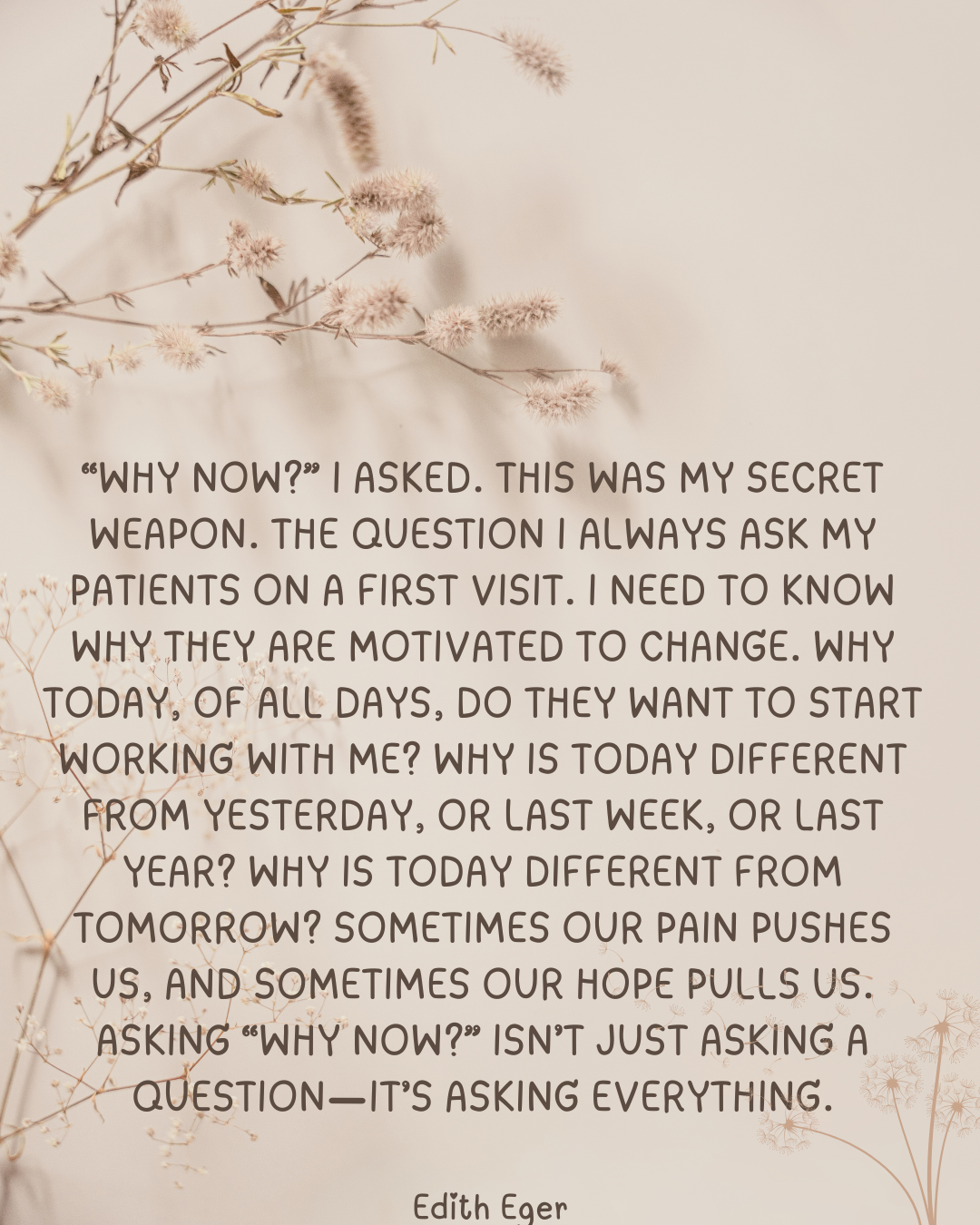
Edith Eger is a Hungarian-born psychologist and Holocaust survivor known for her work on trauma and resilience.
Background: Born in 1927 in Kossice, Hungary, she was deported to Auschwitz as a teenager during World War II. After surviving the Holocaust, she emigrated to America and became a licensed clinical psychologist.
Career and impact: Eger practiced psychotherapy for decades, focusing on trauma recovery for Holocaust survivors and others facing severe trauma. Her approach emphasizes personal responsibility, forgiveness, and finding meaning after suffering.
To be clear: I’m not saying you should ask pointed questions that put others on the spot, like “How can you deliver 10% higher productivity?” or “Are you missing anything here?” The kind of questions leaders need to ask are those that invite people to come together to explore major new opportunities that your organization hasn’t identified yet. Here are some examples:
What is a game-changing opportunity that could create much more value than we have delivered in the past?
What are emerging unmet needs of our customers that could provide the foundation for an entirely new business?
How could we leverage the resources of third parties to address a broader range of the needs of our customers?
How can we move from standardized, mass-market products and services to personalizing our products and services to the specific needs of each customer?
How can we develop supply networks that would be more flexible in responding to unanticipated disruptions in production or logistics?
How could we harness sensor technology to create more visibility into how our customers are using our products and use this information to deliver more value and deepen trust with our customers?
Focusing your questions on these kinds of new and big opportunities rather than on the existing activities of the organization can also help you to sidestep your fear that questioning will be seen as a sign of weakness, since there’s no way you could be expected to know the answers.
These broader questions also communicate that you have a sense of ambition, that you want to take the organization way beyond where it is today. And you can bolster your credibility by providing evidence of those long-term trends that underlie your question – for example, emerging technologies that are likely to offer new opportunities, or demographic shifts that will create some significant unmet needs among your customers.
Ordinarily, we are walking bundles of solutions to problems that no longer exist. Everybody is so. You are carrying thousands of solutions for problems which are no more existent – and you call it knowledge. It is hindering your capacity to know. It is not knowledge.
Drop all the solutions that you are carrying. Drop all the answers that you are carrying. Just remain silent. And whenever a question arises, out of that silence you will hear the answer – and that will be THE answer. It will not come from you, it will not come from scriptures, it will not come from anywhere – it will come from nowhere and it will come from nobody. It will come from your innermost nothingness.
What we often fail to comprehend is that active and assertive listening is THE most important communication skill. In fact, we usually put more effort in how we can get our point across and become more assertive in what we ask and express, than actually realize the significance of our listening skills. We tend to forget that communication is a mutual process of listening to the other and expressing ourselves.
Today our focus will be what prevents us from listening actively and attentively. By recognizing the 12 blocks to listening and realizing when we engage in those, we can subsequently improve our listening skills. This will inevitably bring positive changes in the way we communicate with others.
After all, listening does mean not just hearing with our ears, but actively being mindful and attentive of what is being expressed, so that we first understand it fully. You are what you listen to- and this does not only apply to music!
The 12 Blocks to Active Listening
If you often find yourself in situations that you cannot communicate with someone properly, maybe you are also not listening properly.
Of course it is understandable that we can not always give our full attention to whoever is talking to us- yet understanding what prevents us from doing so is a first step in making necessary adjustments in order to improve our communication. Let’s look at 12 common blocks to listening.
1. Mind Reading
Have you ever caught yourself drifting away from what the other person is saying, because you are already making an assumption in your mind about what they will say?
Although this is to some extent natural and automatic in many conversations, and it may suggest that you understand the other quite well so that you can already guess what they’re about to say, mind reading can become an obstacle in your communication with others.
The reason for this is, the more time you invest in trying to figure out what will be said next, the less involved you are with the present moment and the other person.
After all, no matter how well you know and understand your conversational partner, you are not really in their head- so it is beneficial to actually listen to them rather than presuming you know their next sentence before they utter it.
2. Rehearsing
We can all be guilty of this occasionally; rehearsing means preparing what you will respond next, before your partner has finished talking.
This can often be accompanied by interrupting the other, to say what popped in your mind- which can take a negative turn quite easily, because interrupting is regarded as quite offensive and aggressive and can trigger a defensive attitude of the other person.
Then your focus is on constructing your next argument, not on the person talking to you. Consequently, you focus on yourself and not the other- but listening is all about the other.
It can therefore be worthwhile to pay close attention to them for a bit- it won’t be long until you also have a chance to speak. In addition, the more attentively you listen, the better you will absorb and understand the other’s message- so the more authentic you can be in your response.
3. Filtering
Filtering means having selective attention only to certain types of information, and letting your mind drift away otherwise.
We tend to use filtering when we want to ensure we are not threatened, or when we expect or wish to hear specific things from the other.
For instance, if you feel you are in danger if the other becomes upset, your attention may be more tuned to cues of increased emotion of the other. If the threatening cue is not present, then you can be distracted by your own thoughts and lose concentration.
Understandably, this is a block to effective communication because you do not receive the whole message of whatever the other wants to say- only fragments of it. You basically hear only what you want to hear.
4. Judging
Judging means having a negative opinion that is already firmly established about the other person, or making negative criticism in your mind about what they are saying.
By making judgements or assessing that the other person is not worth listening to, you close yourself from actually hearing what they have to say. Being open and flexible is always an advantage in communication.
5. Daydreaming
Something the other just said triggered a memory, image or thought in your mind- and then you got carried away on your train of thought.
You know how it goes, one thought let to another, and another, and off you go! Suddenly you are disconnected from your partner, lost in your own mind, drifting away. Or you simply lost interest and therefore concentration.
Often when you return to the conversation, you have absolutely no idea of what has been said so far. You may feel confused or awkward. This can be very embarrassing in some occasions, especially when you ask a question about something that has already been expressed while you were off somewhere far. It is quite obvious that such a thing is disrespectful to the other person.
“When we decide, we’re always worrying- ‘did I think this over long enough? did I take enough data into consideration?’- and if you think it through you find that you never could take enough data into consideration. The data for a decision in any given situation is infinite. So what you do is: you go through the motions of thinking about what you will do about this, and then when the time comes to act you make a snap judgment. But we fortunately forget the variables that could have interfered with this coming out right. It’s amazing how often it works.” –Alan Watts
It starts by standing with the poor, listening to voices unheard, and recognizing potential where others see despair.
It demands investing as a means, not an end, daring to go where markets have failed and aid has fallen short. It makes capital work for us, not control us.
It thrives on moral imagination: the humility to see the world as it is, and the audacity to imagine the world as it could be. It’s having the ambition to learn at the edge, the wisdom to admit failure, and the courage to start again.
It requires patience and kindness, resilience and grit: a hard-edged hope. It’s leadership that rejects complacency, breaks through bureaucracy, and challenges corruption. Doing what’s right, not what’s easy.
it’s the radical idea of creating hope in a cynical world. Changing the way the world tackles poverty and building a world based on dignity.Continue reading →
“It seems a farmer was out working his field when his plow caught on something, and it wouldn’t budge. The horse reared up and the farmer cursed. After calming the horse the farmer yanked back on the braces. But the plow still wouldn’t budge. Because he was an impatient man his first reaction was to go into Judger. Had a rock or other obstacle broken his plowshare? That could mean losing at least two days’ work while he hauled the broken parts to the blacksmith! Cursing, he began digging around to free the plow. To his surprise, he discovered that it was caught on an iron ring buried six inches under the ground. After freeing his plow, the farmer got curious. He cleared away some of the dirt and pulled on the iron ring. Off came the lid of an ancient chest. He peeked down inside it. Before him, glittering in the sun, lay a treasure of precious jewels and gold.
Where you stumble, there your treasure is
This story reminds us that it is often by confronting our toughest obstacles that we find our greatest strengths and possibilities, but sometimes we’ve got to dig deep to find them. Campbell had a phrase for it: Where you stumble, there your treasure is.
To uncover that treasure you’d ask yourself questions like: What could I discover? What haven’t I noticed before? What might be valuable here?”
Change Your Questions, Change Your Life: 12 Powerful Tools for Leadership, Coaching, and Lifeby Marilee Adams and Marshall Goldsmith
With our questions we make the world. Questions open our minds, our eyes, and our hearts. With our questions we learn, connect, and create. We are smarter, more productive, and able to get better results. We shift our orientation from fixed opinions and easy answers to curiosity, thoughtful questions, and open-minded conversations, lighting the way to collaboration, exploration, discovery, and innovation. I have a vision of workplaces and a society—of individuals, families, organizations, and communities—that are vibrant with the spirit of inquiry and possibility.
– Marilee Adams
“Question Thinking is a system of skills and tools using questions to expand how you approach virtually any situation. You develop the skills to refine your questions for vastly better results in anything you do. That begins with asking questions of ourselves and only then asking them of others.”
“…..Questions drive results…..”
Change Your Questions, Change Your Life: 12 Powerful Tools for Leadership, Coaching, and Life by Marilee Adams and Marshall Goldsmith‘
Ask questions and listen to the quiet voice within.
Questions allow us to gain clarity…….
….Too often we only ask question that we think we already know the answer to. It is immediately obvious that the person asking the question is already convinced that they have the perfect solution and are hoping that we will recognise that solution in the veiled question so we agree with them!





 ONE TUSK