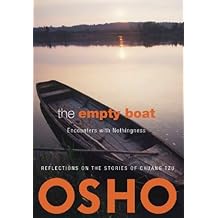
Talks on the Stories of Chuang Tzu. OSHO revitalises the 300-year-old Taoist message of self-realization through the stories of the Chinese mystic, Chuang Tzu. He speaks about the state of egolessness, “the empty boat”; spontaneity, dreams and wholeness; living life choicelessly and meeting death with the same equanimity. Continue reading
Thought for the Week – 30th April 2018
The donkey dies of exhaustion
Nasrudin decided to go in search of some new meditation techniques. He saddled his donkey, went to India, China and Mongolia, talked to the great masters, but found nothing.
View original post 226 more words
We need more producers across all industries….
What a Producer Does
He has an idea and pursues it; or he learns of someone else’s idea and seeks the means to realize upon it … indeed, to be sure that it is improved upon. A good producer, as an inspirer of creativity, must, himself, be creative. He is a creative administrator … a judge of creativity. He guides and helps hundreds of people toward an objective that becomes increasingly clear-cut as the work proceeds from an idea, through its script and budget preparation, then to shooting (very tense and money hazardous), then to post-production (cost manageable and leisurely if you don’t have a pressing air date or release deadline). It’s like herding bees with a switch. Continue reading
Thought for the Week – 23rd April 2018
No blame, no reasoning, no argument, just understanding

“When you plant lettuce, if it does not grow well, you don’t blame the lettuce. You look for reasons it is not doing well.
View original post 97 more words
Thought for the Week – 16th April 2018
Unless you disappear totally, the real cannot arise. You are the barrier….
Be aware that through me you are not going to gain anything. Through me you can only lose all – because unless you are lost, the divine cannot happen; unless you disap¬pear totally, the real cannot arise. You are the barrier.
And you are so much, so stubbornly much, you are so filled with yourself that nothing can penetrate you. Your doors are closed. When you disappear, when you are not, the doors open. Then you become just like the vast, infinite sky.
That is your nature. That is Tao.
Before I enter into Chuang Tzu’s beautiful parable of The Empty Boat, I would like to tell you one other story, because that will set the trend for this meditation camp which you are entering.
I have heard …
It happened once, in some ancient time, in some unknown country, that a prince suddenly went mad. The king was desperate – the prince was the only son, the only heir to the kingdom. All the magicians were called, miracle makers, medical men were summoned, every effort was made, but in vain. Nobody could help the young prince, he remained mad. Continue reading
Sāksātkāra – where perception and conceptualization are in complete agreement
First, an aspirant attentively listens to the sayings of the Upanishads from a preceptor who is Brahman-conscious all the time. In the second step, he practices vichāra (contemplation), which means that he goes to the depths of the great sayings and determines to practice them with mind, action, and speech.