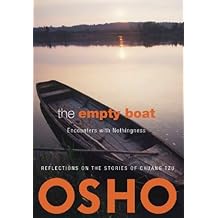
Talks on the Stories of Chuang Tzu. OSHO revitalises the 300-year-old Taoist message of self-realization through the stories of the Chinese mystic, Chuang Tzu. He speaks about the state of egolessness, “the empty boat”; spontaneity, dreams and wholeness; living life choicelessly and meeting death with the same equanimity. Continue reading
Pause and Reflect
Unless you disappear totally, the real cannot arise. You are the barrier….
Be aware that through me you are not going to gain anything. Through me you can only lose all – because unless you are lost, the divine cannot happen; unless you disap¬pear totally, the real cannot arise. You are the barrier.
And you are so much, so stubbornly much, you are so filled with yourself that nothing can penetrate you. Your doors are closed. When you disappear, when you are not, the doors open. Then you become just like the vast, infinite sky.
That is your nature. That is Tao.
Before I enter into Chuang Tzu’s beautiful parable of The Empty Boat, I would like to tell you one other story, because that will set the trend for this meditation camp which you are entering.
I have heard …
It happened once, in some ancient time, in some unknown country, that a prince suddenly went mad. The king was desperate – the prince was the only son, the only heir to the kingdom. All the magicians were called, miracle makers, medical men were summoned, every effort was made, but in vain. Nobody could help the young prince, he remained mad. Continue reading
Sāksātkāra – where perception and conceptualization are in complete agreement
First, an aspirant attentively listens to the sayings of the Upanishads from a preceptor who is Brahman-conscious all the time. In the second step, he practices vichāra (contemplation), which means that he goes to the depths of the great sayings and determines to practice them with mind, action, and speech.Repetition is the method to convert a lie into a truth
But can you convert a lie into a truth? Just in appearance you can. Try it. Go on repeating something and you will start believing it. It may be that you are not as miserable as you look. Because you have been repeating, “I am in misery, I am in misery, I am in misery,” and you have repeated it so often, now you look miserable. Just look into your misery. Are you really miserable, really in such hell as you show by your face? Have a second thought. Immediately you will not feel so miserable because nobody can be as miserable as you look.
-Osho
We cannot always place responsibility outside of ourselves, on parents, nations, the world, society, race, religion….
We receive a fatal imprint in childhood, at the time of our greatest plasticity, of our passive impressionism, of our helplessness before suggestion. In no period has the role of the parents loomed as immense, because we have recognized the determinism, but at the same time an exaggeration in the size of the Enormous Parent does not need to be permanent and irretrievable. Continue reading
Severing the Ties that Bind us through the practice of forgiveness
While there are shamanic techniques for cutting the cords that energetically tie us to another person, we can also sever these bonds through the practice of forgiveness. Continue reading
The Empty Boat
The Empty Boat by Chuang Tzu
He who rules men lives in confusion;
He who is ruled by men lives in sorrow.
Yao therefore desired
Neither to influence others
Nor to be influenced by them.
The way to get clear of confusion
And free of sorrow
Is to live with Tao
In the land of the great Void.
If a man is crossing a river
And an empty boat collides with his own skiff,
Even though he be a bad-tempered man
He will not become very angry.
But if he sees a man in the boat,
He will shout at him to steer clear.
If the shout is not heard, he will shout again,
And yet again, and begin cursing.
And all because there is somebody in the boat.
Yet if the boat were empty.
He would not be shouting, and not angry.
If you can empty your own boat
Crossing the river of the world,
No one will oppose you,
No one will seek to harm you.
The straight tree is the first to be cut down,
The spring of clear water is the first to be drained dry.
If you wish to improve your wisdom
And shame the ignorant,
To cultivate your character
And outshine others;
A light will shine around you
As if you had swallowed the sun and the moon:
You will not avoid calamity.
A wise man has said:
“He who is content with himself
Has done a worthless work.
Achievement is the beginning of failure.
Fame is beginning of disgrace.”
Who can free himself from achievement
And from fame, descend and be lost
Amid the masses of men?
He will flow like Tao, unseen,
He will go about like Life itself
With no name and no home.
Simple is he, without distinction.
To all appearances he is a fool.
His steps leave no trace. He has no power.
He achieves nothing, has no reputation.
Since he judges no one
No one judges him.
Such is the perfect man:
His boat is empty.
-Chuang Tzu
Maturity
“When I say maturity, I mean an inner integrity. And this inner integrity comes only when you stop making others responsible, when you stop saying that the other is creating your suffering, when you start realizing that you are the creator of your suffering. This is the first step towards maturity: I am responsible. Whatsoever is happening, it is my doing. Continue reading
But what about Listening?
“Communication is the most important skill in life. You spend years learning how to read and write, and years learning how to speak. But what about listening? What training have you had that enables you to listen so you really, deeply understand another human being? Probably none, right? Continue reading
By a mere look…
Swami chinmayananda’s experience
“I was just emerging from high school, exams were over. On a package railway ticket I was roaming through south India. As the train steamed through the country side at a halting speed, most of the passengers in my compartment suddenly peered through the windows in great excitement and bowed revertentially to the elaborate temple beyond. Inquiring about it, I was told that it was the Tiruvannamalai temple.
Thereafter, the talk of my fellow travellers turned to Ramana Maharshi. The word “Maharshi” conjured up in my mind ancient forest retreats and superhuman beings of divine glow. Though I was at that time a convinced atheist, I was deeply drawn to visit the Maharshi’s Ahsram. I chose to take the next available train to Tiruvannamalai. Continue reading