Habits are the compound interest of self-improvement. The same way that money multiplies through compound interest, the effects of your habits multiply as you repeat them. They seem to make little difference on any given day and yet the impact they deliver over the months and years can be enormous. It is only when looking back two, five, or perhaps ten years later that the value of good habits and the cost of bad ones becomes strikingly apparent.
Summary:Think Again (Canada/US) explores the power of rethinking in a world where certainty and dogma often spread like wildfire.
Much of the time, we hold onto our deeply cherished beliefs and seek out confirming evidence for them. In the process, we settle on beliefs that may be flawed and rarely, if ever, revisit them.
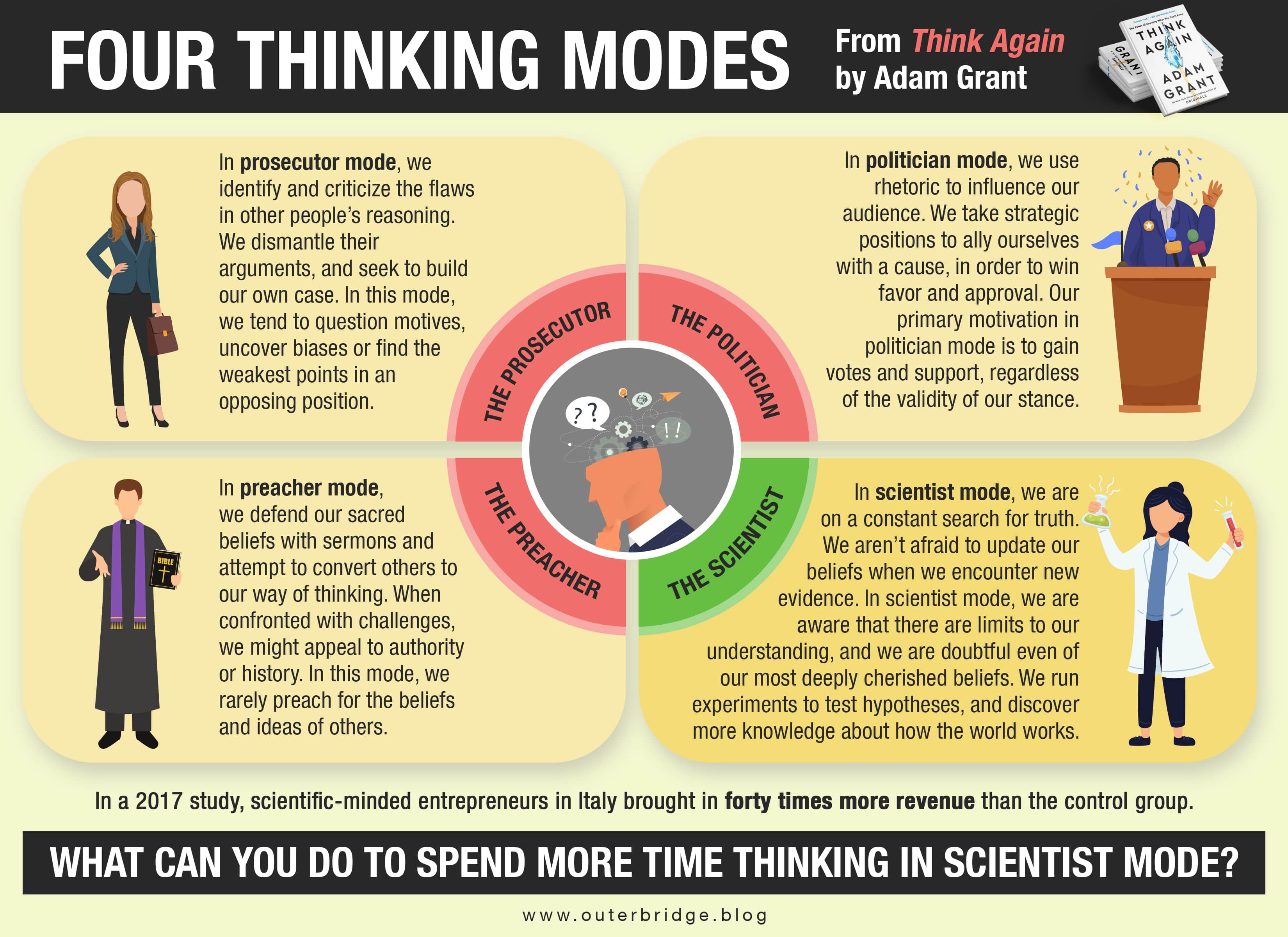
When we do so, we act in three main roles: as preachers trying defend our beliefs from questioning, as prosecutors attacking the arguments of the opposition, and as politicians using rhetoric to persuade others to our point of view.
However, there is a fourth role that is often neglected: that of a scientist questioning a hypothesis.
I co-created an infographic outlining these four modes of thinking. Check it out :
Renowned researcher and author Jim Collins makes his second appearance on The Knowledge Project, this time to share a wealth of life lessons learned from his mentor and collaborator, Bill Lazier. Jim recently released BE 2.0 (Beyond Entrepreneurship 2.0), an ambitious upgrade of his first book Beyond Entrepreneurship, co-authored with Lazier and focused on effective leadership style. Shane discusses all new topics with Jim in their follow-up conversation, including what it means to be a mentor and a father, why we should trust by default, why we confuse living a long life with a great life, and the difference between being afraid of risk and being afraid of ambiguity.
Elon Musk’s entrepreneurial success is a direct result of his mindset, strategies, and intelligence.
Having known Elon for 20 years, I’ve had the opportunity to watch his meteoric rise into someone who is arguably the greatest entrepreneur of our age.
In this blog, I’ll summarize what every exponential entrepreneur can learn and emulate from Elon’s core success tactics and strategies.
I’ve divided these lessons into 6 sections:
Deep-rooted Passion
Massively Transformative Purpose
Singular, Unwavering Focus
First Principles Thinking
Thinking in Probabilities
Not Settling for “No” / Not Giving Up
Let’s dive in…
1. DEEP-ROOTED PASSION
“I didn’t go into the rocket business, the car business, or the solar business thinking, ‘This is a great opportunity.’ I just thought, in order to make a difference, something needed to be done. I wanted to create something substantially better than what came before.” – Elon Musk
Elon only tackles those problems where he has deep-rooted passion and conviction.
After selling PayPal, with $165M in his pocket, he set out to pursue three Moonshots, and subsequently built three multibillion-dollar companies: SpaceX, Tesla, and SolarCity.
This passion (and the underlying emotional drive) allowed him to push forward through extraordinarily difficult times and take big risks.
You might think it was always easy for Elon, but back in 2008 he was at a lowest low: SpaceX had just experienced its third consecutive failure of the Falcon-1 launch vehicle, Tesla was out of money, SolarCity was not getting financed, and Musk was going through a divorce.
He had to borrow money for basic living. Traumatic times.
Despite the 2008 economic crisis at the time, he bet every penny he had, and eventually everything turned around. Going from being in debt, to the wealthiest person on the planet just 13 years later. Wow, what a journey!
Ultimately, it was his passion, refusal to give up, and drive that allowed him to ultimately succeed and begin to impact the world at a significant scale.
2. CLEAR MASSIVELY TRANSFORMATIVE PURPOSE(S)
Part of Elon’s ability to motivate his teams to do great things is his crystal-clear Massively Transformative Purpose (MTP), which drives each of his companies.
As I always say, social movements, rapidly growing organizations, and remarkable breakthroughs in science and technology are all backed by a powerful MTP.
Elon’s MTP for Tesla and SolarCity is to accelerate the world’s transition to sustainable energy.
To this end, every product Tesla brings to market is focused on this vision and backed by a Master Plan he wrote nearly 15 years ago.
Elon’s MTP for SpaceX is to backup the biosphere by making humanity a multi-planet species.
Elon has been preaching this since the founding of SpaceX back in 2002, even when he was experiencing numerous rocket failures.
“I think fundamentally the future is vastly more exciting and interesting if we’re a spacefaring civilization and a multi-planet species than if we’re or not. You want to be inspired by things. You want to wake up in the morning and think the future is going to be great. And that’s what being a spacefaring civilization is all about.” – Elon Musk
MTPs are like a north star for any exponential entrepreneur and their employees.
They keep all efforts focused and aligned, which helps his organizations grow cohesively even in times of chaos.
And when you combine passion and purpose, that gives you something else…
3. SINGULAR, UNWAVERING FOCUS
Elon is notorious for working 75 – 80 hour weeks, especially in the early days of SpaceX and Tesla.
There were times during Tesla’s early days where a specific problem needed to be solved, so he would sleep under his desk or on the factory floor if he had to. Elon didn’t think about anything else—all he focused on was the task at hand.
And now look at Tesla: it’s a giant transforming the automotive world.
Passion, purpose, and focus. All of these put you into what psychologists call a flow state: a highly enjoyable and meaningful state where work ceases to become work and instead becomes energizing and immersive.
This intensity that Elon brings is different from the kind of intensity that burns people out or causes them to quit jobs. For him, the intensity is energizing—not draining.
4. FIRST PRINCIPLES THINKING
First principles thinking is a mode of inquiry borrowed from physics that is designed to relentlessly pursue the foundations of any given problem from fundamental truths.
Elon has deployed this thinking strategy to give himself an unfair advantage when developing new batteries, a key component for both Tesla and SolarCity.
Here is Elon describing first principles thinking in an interview with Kevin Rose:
“I think it is important to reason from first principles rather than by analogy. The normal way we conduct our lives is we reason by analogy. [When reasoning by analogy] we are doing this because it’s like something else that was done or it is like what other people are doing — slight iterations on a theme.
First principles is kind of a physics way of looking at the world. You boil things down to the most fundamental truths and say, “What are we sure is true?” … and then reason up from there.
Somebody could say, “Battery packs are really expensive and that’s just the way they will always be… Historically, it has cost $600 per kilowatt hour. It’s not going to be much better than that in the future.”
With first principles, you say, “What are the material constituents of the batteries? What is the stock market value of the material constituents?”
It’s got cobalt, nickel, aluminum, carbon, some polymers for separation and a sealed can. Break that down on a material basis and say, “If we bought that on the London Metal Exchange what would each of those things cost?”
It’s like $80 per kilowatt hour. So clearly you just need to think of clever ways to take those materials and combine them into the shape of a battery cell and you can have batteries that are much, much cheaper than anyone realizes.”
First principles thinking works so well because it gives us a proven strategy for editing out complexity and allows entrepreneurs to sidestep the tide of popular opinion.
“If you want to be successful in business (in life, actually), you have to create more than you consume. Your goal should be to create value for everyone you interact with. Any business that doesn’t create value for those it touches, even if it appears successful on the surface, isn’t long for this world. It’s on the way out.”
“In what ways does the world pull at you in an attempt to make you normal? How much work does it take to maintain your distinctiveness? To keep alive the thing or things that make you special?
I know a happily married couple who have a running joke in their relationship. Not infrequently, the husband looks at the wife with faux distress and says to her, “Can’t you just be normal?” They both smile and laugh, and of course the deep truth is that her distinctiveness is something he loves about her. But, at the same time, it’s also true that things would often be easier – take less energy – if we were a little more normal.
We all know that distinctiveness – originality – is valuable. We are all taught to “be yourself.” What I’m really asking you to do is to embrace and be realistic about how much energy it takes to maintain that distinctiveness. The world wants you to be typical – in a thousand ways, it pulls at you. Don’t let it happen.
You have to pay a price for your distinctiveness, and it’s worth it. The fairy tale version of “be yourself” is that all the pain stops as soon as you allow your distinctiveness to shine. That version is misleading. Being yourself is worth it, but don’t expect it to be easy or free. You’ll have to put energy into it continuously.
The world will always try to make Amazon more typical – to bring us into equilibrium with our environment. It will take continuous effort, but we can and must be better than that.
Q: What are the key modes of thinking that drive our values and beliefs?
[Adam Grant]: Two decades ago, I read a brilliant paper by Phil Tetlock, who introduced me to this idea of thinking like a preacher, a prosecutor or a politician. Once I’d gotten that framework into my head, I couldn’t let it go. I saw it everywhere… I saw it in my own thinking… in other people’s thinking… I saw it in the way we communicate.
The basic idea is that when you’re preaching, you’re trying to proselytise to other people and defend your sacred beliefs. When you’re prosecuting, you’re trying to win an argument which means you’re going to have to prove the other side wrong. My big worry is when we’re locked into a preacher or prosecutor mindset, we’re not willing to question our own assumptions and opinions… if I’m right, and you’re wrong, then I get to stand still, and you are the one who needs to change. In politicianmode, things are a little more flexible. In that mode, I’m trying to win the approval of an audience – and that means I’m going to lobby or campaign. I might say things you want to hear, but I might not be actually changing what I really think or- if I do- I might be doing it to appease my tribe rather than to find the truth.
What happened with Gamestop is the beginning of economic populism. Robinhood weaponized the Occupy Wall Street movement, social drove viral interest, and nearly everyone hates Wall Street and Robinhood. There’s a lot to unpack here, political, economic, social, and technological, but understanding how all these themes come together is crucial to understand the future of fintech…..


 ONE TUSK