transformation
Millennial Question
Above all else I want to see differently
Letting go involves being aware of a feeling, letting it come up, staying with it, and letting it run its course without wanting to make it different or do anything about it. It means simply to let the feeling be there and to focus on letting out the energy behind it
.
The first step is to allow yourself to have the feeling without resisting it, venting it, fearing it, condemning it, or moralizing about it. It means to drop judgment and to see that it is just a feeling.
Your success as a 3rd Alternative thinker will come from the inside out….
 Your success as a 3rd Alternative thinker will come from the inside out.
I recommend twenty things that I’ve found to be very helpful in developing the inner strength and security to create 3rd Alternative solutions:
1. Beware of pride. Let go of needing always to be “right.” Your grasp on reality is always partial anyway. Allow yourself to achieve the important breakthroughs in relationships and creative solutions that will never likely be realized if you stubbornly hold on to being “right.”
2. Learn to say “I’m sorry.” Do it quickly once you realize you’ve fallen short or hurt someone. Be sincere and don’t hold back. And don’t go just half way. Apologize fully, take responsibility, and express your desire to understand.
3. Be quick to forgive perceived slights. Remember, you choose whether or not to be offended. If you feel offended, let it go.
4. Make and keep very small promises to yourself and others. Take baby steps. As you create a pattern of doing so, make and keep bigger promises. Your own integrity will become your greatest source of security and strength.
5. Spend time in nature. Go on long walks. Create space in your life every day for reflection on the synergies of the world around you.
6. Read widely—it’s one of the best ways to make mental connections and get insights that can lead to 3rd Alternatives.
7. Exercise often, each day if possible; and eat healthy food, with balance and moderation. The body is the instrument of the mind and spirit.
8. Get enough sleep, at least 7 to 8 hours daily. Science tells us that the brain grows new connections during sleep, which is why we often awake with sparkling new ideas. And you’ll find yourself so much more able to give the emotional, mental, and spiritual energy needed to create 3rd Alternatives.
9. Study inspiring or sacred literature. Ponder, meditate, or pray. Insights will come.
10. Make quiet time for yourself to think through creative 3rd Alternative solutions to your challenges.
Every Feeling is a Field of Energy
 Because emotions emit a vibrational energy field, they affect and determine the people who are in our lives. Life events become influenced by our repressed and suppressed emotions on the psychic level. Thus anger attracts angry thoughts. The basic rule of the psychic universe is that “like attracts like.” Similarly, “love promotes love,” so that the person who has let go of a lot of inner negativity is surrounded by loving thoughts, loving events, loving people, and loving pets.
Learning to Grow Up
 Organizations have been built on the notion that people must be held accountable and that someone else is in charge of doing that. This kind of thinking, more than anything else, creates and maintains parent–child conversations in the workplace that foster cultures relying on compliance rather than commitment. The idea that we are all responsible for our own commitment is radical.
Book Recommendation : Radical Candor by Kim Scott
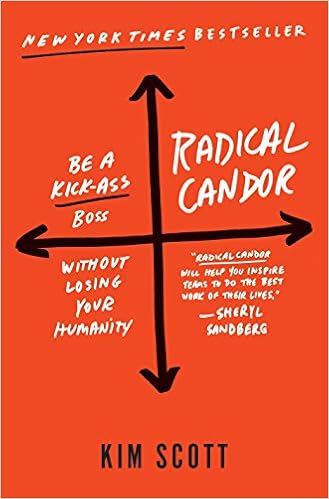 From the time we learn to speak, we’re told that if you don’t have anything nice to say, don’t say anything at all. When you become a manager, it’s your job to say it–and your obligation.
Author Kim Scott was an executive at Google and then at Apple, where she worked with a team to develop a class on how to be a good boss. She has earned growing fame in recent years with her vital new approach to effective management, Radical Candor.
Radical Candor is a simple idea: to be a good boss, you have to Care Personally at the same time that you Challenge Directly. When you challenge without caring it’s obnoxious aggression; when you care without challenging it’s ruinous empathy. When you do neither it’s manipulative insincerity.
This simple framework can help you build better relationships at work, and fulfill your three key responsibilities as a leader: creating a culture of feedback (praise and criticism), building a cohesive team, and achieving results you’re all proud of.
Radical Candor offers a guide to those bewildered or exhausted by management, written for bosses and those who manage bosses. Taken from years of the author’s experience, and distilled clearly giving actionable lessons to the reader; it shows managers how to be successful while retaining their humanity, finding meaning in their job, and creating an environment where people both love their work and their colleagues.
( Recommended by Fanny Limare-Wolf) Continue reading
In the new economy, management and leadership are not easily separated
 In his 1989 book “On Becoming a Leader,” Warren Bennis composed a list of the differences between managers and leaders:
– The manager administers; the leader innovates.
– The manager is a copy; the leader is an original.
– The manager maintains; the leader develops.
– The manager focuses on systems and structure; the leader focuses on people.
– The manager relies on control; the leader inspires trust.
– The manager has a short-range view; the leader has a long-range perspective.
– The manager asks how and when; the leader asks what and why.
– The manager has his or her eye always on the bottom line; the leader’s eye is on the horizon.
– The manager imitates; the leader originates.
– The manager accepts the status quo; the leader challenges it.
– The manager is the classic good soldier; the leader is his or her own person.
– The manager does things right; the leader does the right thing. Continue reading
Bring Love and Compassion
When Anthony Ray Hinton went to death row after a trial that can only be called a travesty of justice, he was understandably angry and heartbroken at how the American justice system had failed him. “When no one believes a word you say, eventually you stop saying anything. I did not say good morning. I did not say good evening. I did not say a how-do-you-do to anyone. If the guards needed some information from me, I wrote it down on a piece of paper. I was angry.
Knowledge can be conveyed, but not wisdom
Look, my dear Govinda, this is one of my thoughts, which I have found: wisdom cannot be passed on. Wisdom which a wise man tries to pass on to someone always sounds like foolishness.”
 “Are you kidding?” asked Govinda. “I’m not kidding. I’m telling you what I’ve found. Knowledge can be conveyed, but not wisdom. It can be found, it can be lived, it is possible to be carried by it, miracles can be performed with it, but it cannot be expressed in words and taught. This was what I, even as a young man, sometimes suspected, what has driven me away from the teachers.
 ONE TUSK