If you can understand that everyone has come to learn….


You’re actually above the other only in your own idealization of your own behavior. You are not above them, they are not below you. They are having a different encounter with themselves, and perhaps learning through it, and perhaps giving you the opportunity to learn as well. If you assume that someone is not where they are supposed to be, you have decided for them based upon what you think they should be, or perhaps where or how they should behave based upon your idealisation of behaviour…..

This does not make them wrong. Do you understand this? It doesn’t make you wrong, either, but it certainly doesn’t make you right……

If you can understand that everyone has come to learn—how they learn their lessons is in some ways decided by them at a higher level—you learn not to judge.

You don’t have to enable, you don’t have to agree….

Do you understand this, yes?

– Paul Selig

Enlightenment

“Enlightenment is not something that occurs in the future, after 50 years of sitting cross-legged and saying “OM.” It is right here, in this instant. The reason you’re not experiencing this state of total peace and timelessness is because it is being resisted. It is being resisted because you are trying to control the moment. If you let go of trying to control your experience of the moment, and if you constantly surrender it like a tone of music, then you live on the crest of this exact always-ness. Experience arises like a note of music. The minute you hear a note, it’s already passing away. The instant you’ve heard it, it’s already dissolving. So every single moment is dissolving as it arises. Let go of anticipating the next moment, trying to control it, trying to hang on to the moment that has just passed. Let go clinging to what has just occurred. Let go trying to control what you think is about to occur. Then you live in an infinite space of non-time and non-event. There is an infinite peace beyond description. And you are home.”

David Hawkins from Letting Go

Book of the Month – December 2021

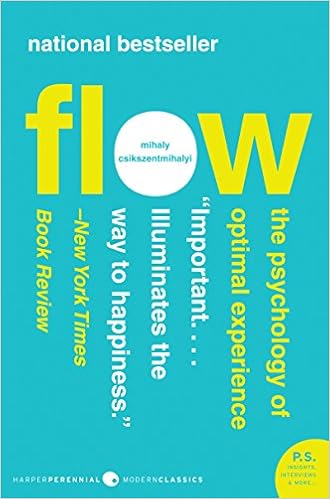
Psychologist Mihaly Csikszentmihalyi’s famous investigations of “optimal experience” have revealed that what makes an experience genuinely satisfying is a state of consciousness called flow. During flow, people typically experience deep enjoyment, creativity, and a total involvement with life. In this new edition of his groundbreaking classic work, Csikszentmihalyi demonstrates the ways this positive state can be controlled, not just left to chance. Flow: The Psychology of Optimal Experience teaches how, by ordering the information that enters our consciousness, we can discover true happiness and greatly improve the quality of our lives.
Continue reading

Notes to Myself – Bombay Jayashri

The aim and final end of all music should be none other than the glory of God and the refreshment of the soul. by Johann Sebastian Bach
Notes to Myself is one of MOPA’s flagship projects – a series of interactive, expository documentaries that deconstructs the lives and creative processes of some of the most impactful professionals associated with South India’s performing arts. Done in a let-your-hair-down and from-the-heart way, these offer an honest, moving and at times funny and charmingly unguarded look at the lives of these artistes.

This is the voice of Bombay Jayashri, a singer who has performed widely and successfully across genres – Carnatic music, Indian film playback singing, semi-classical music, fusion and more.

The real ‘You’ Comes and Goes…..

“You cannot catch hold of it, nor can you get rid of it. In not being able to get it, you get it. When you speak it is silent. When you are silent it speaks.”

Zen Poem

Book of the Month – September 2021 : Essays on the Gita by Sri Aurobindo

“The peculiarity of the Gita among the great religious books of the world is that it does not stand apart as a work by itself, the fruit of the spiritual life of a creative personality like Christ, Mohammed or Buddha or of an epoch of pure spiritual searching like the Veda and Upanishads, but is given as an episode in an epic history of nations and their wars and men and their deeds and arises out of a critical moment in the soul of one of its leading personages face to face with the crowning action of his life, a work terrible, violent and sanguinary, at the point when he must either recoil from it altogether or carry it through to its inexorable completion…. The teaching of the Gita must therefore be regarded not merely in the light of a general spiritual philosophy or ethical doctrine, but as bearing upon a practical crisis in the application of ethics and spirituality to human life.” – Sri Aurobindo (Essays on the Gita pp.9)

Continue reading