mindfulness
Habits are the compound interest of self-improvement….
Habits are the compound interest of self-improvement. The same way that money multiplies through compound interest, the effects of your habits multiply as you repeat them. They seem to make little difference on any given day and yet the impact they deliver over the months and years can be enormous. It is only when looking back two, five, or perhaps ten years later that the value of good habits and the cost of bad ones becomes strikingly apparent.
– James Clear
How to Stop Overthinking ?
What are you so Busy About?
When was the last time you made the time to be silent and still? When was the last time you carved out a chunk of time to enjoy the power of solitude to restore, refocus and revitalize your mind, body and spirit?
All of the great wisdom traditions of the world have arrived at the same conclusion: to reconnect with who you really are as a person and to come to know the glory that rests within you, you must find the time to be silent on a regular basis. Sure, you are busy. But as Thoreau said: “It is not enough to be busy, so are the ants. The question is what are you so busy about?”

Experiencing solitude, for even a few minutes a day, will keep you centered on your highest life priorities and help you avoid the neglect that pervades the lives of so many of us. And saying that you don’t have enough time to be silent on a regular basis is a lot like saying you are too busy driving to stop for gas – eventually it will catch up with you.
Robin Sharma from Who Will Cry When you Die?
Emotions: The Hidden Risk Factor for Heart Disease
Dr. Stephen Sinatra

Early in my career, as part of my effort to understand how our emotions affect heart health, I trained as a psychotherapist. I discovered then that our heart is indeed much more than a pump.
We all know the sayings, “you touched my heart,” “you stole my heart,” and “my heart is broken.” The heart is the only organ in the body that carries such emotionally charged meaning. But more importantly, these sayings are not simply images; they can describe real, physical, medical events in the heart. The “heavy heart” that comes with sadness, for example, can actually lead to chest pain.
Our emotions and our stresses are far bigger risk factors for heart disease than we acknowledge them to be. When stressed, the body floods itself with the hormones cortisol and adrenaline. Over time, an overdose of these hormones can lead to symptoms such as heart palpitations, ulcers, stroke, or heart attack. So, although we may tell ourselves that we are not as upset as we think we are, our emotions show themselves in other ways.
Simply put, the body never lies. Do not neglect the emotional risk factors for heart disease. How can you reduce such stressors? Here are 15 ways to keep emotions from putting your heart at risk.
- Explore Your Anger. Anger is the Achilles’ heel of the cardiovascular system—a trigger for serious problems, including a heart attack. Your blood vessels constrict and your blood pressure rises. The electrical currents to your heart become unstable. And if you have arterial plaque, anger is like throwing a match into a can of gasoline. The plaque can rupture, and the resulting clots can kill you.
One of the best ways to keep anger from becoming a risk factor for heart disease is to release it. Find a place of solitude and scream, yell, or cry. Talk to a friend or visit a skilled psychotherapist to work on your anger. Or, try twisting towels, hitting tennis balls, or punching pillows. It also helps to ask yourself why you feel angry. Recognize that you cannot be effective when you are possessed by anger. If you understand why you’re coming to such an emotional point, you’ll be better able to identify and avoid those triggers……….
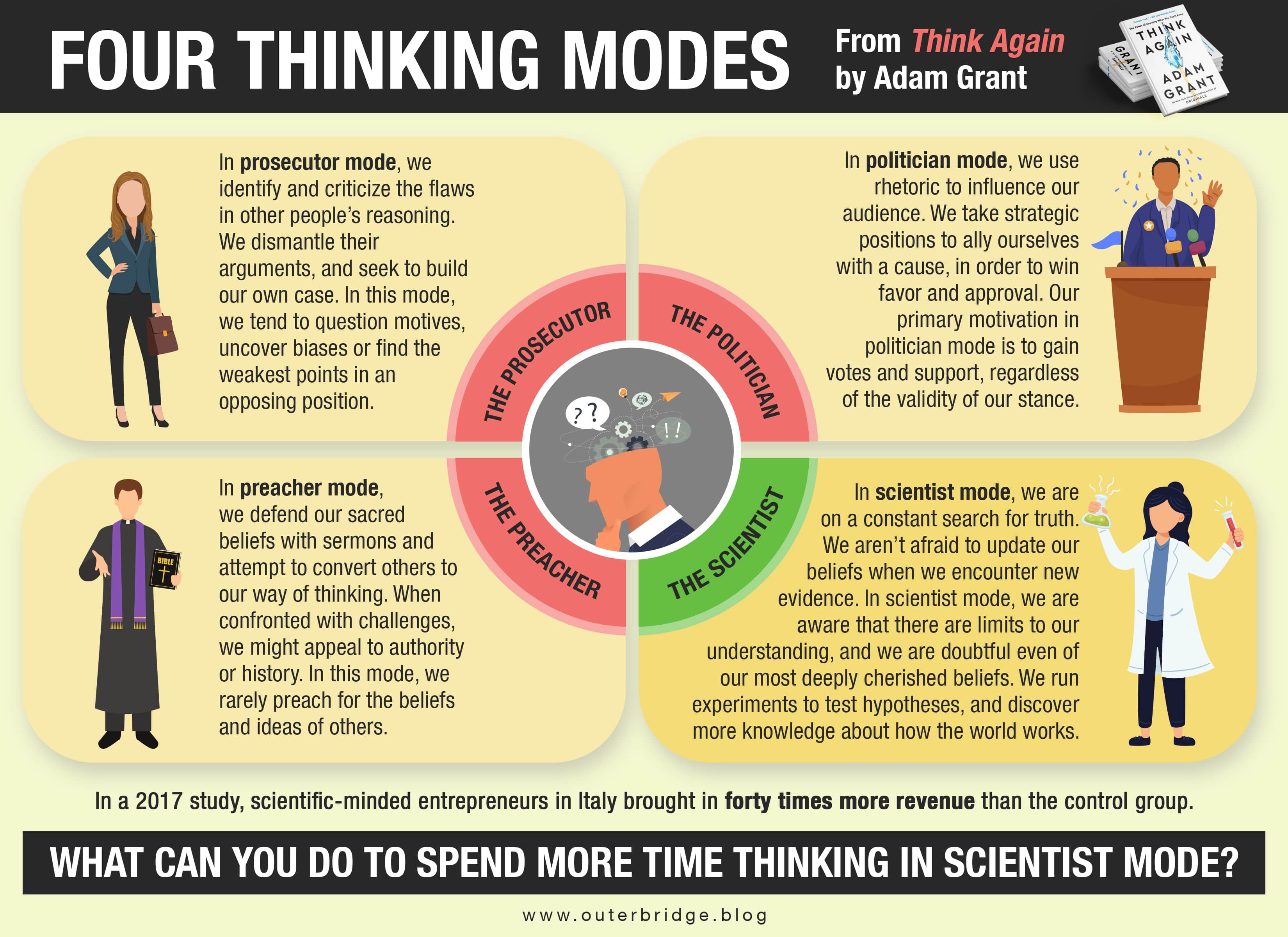
Four Thinking Modes by Adam Grant
| THINK AGAIN — ADAM GRANT4/3/20210 Comments Rating: ★★★★½ Summary: Think Again (Canada/US) explores the power of rethinking in a world where certainty and dogma often spread like wildfire. Much of the time, we hold onto our deeply cherished beliefs and seek out confirming evidence for them. In the process, we settle on beliefs that may be flawed and rarely, if ever, revisit them. When we do so, we act in three main roles: as preachers trying defend our beliefs from questioning, as prosecutors attacking the arguments of the opposition, and as politicians using rhetoric to persuade others to our point of view. However, there is a fourth role that is often neglected: that of a scientist questioning a hypothesis. I co-created an infographic outlining these four modes of thinking. Check it out : |
What Meditation is not….
Silence is Key
Why the Urge to Improve?
Mental Health and Self Discovery – Documentary
Chasing the Present
( Recommended by Craig C)
https://www.imdb.com/title/tt10663414/

A materially successful young man, riddled with anxiety embarks on a world-wide journey of self-inquiry. From the streets of NY, to the stillness of the Ganges, and deep into the jungles of Peru, he immerses himself in meditation, self-inquiry, and plant medicine whilst conversing with top experts like Russell Brand, Alex Grey, Graham Hancock, Joseph Goldstein, Rupert Spira, Sri Prem baba, Zelda Hall, and more to find the root cause of the problem and learn how to finally find freedom from his crippling anxiety. He finds answers to why a person who seemingly has it all can continue to suffer from debilitating panic attacks, whilst recognizing the beauty and power that lies within each of us, if we are willing to go there. Let your journey begin with Chasing the Present.
 ONE TUSK