( Recommended by Justin B)
Lessons from 30 Years of building
( Recommended by Justin B)
( Recommended by Justin B)
Jeff Bezoz’s final letter as CEO of Amazon.
“If you want to be successful in business (in life, actually), you have to create more than you consume. Your goal should be to create value for everyone you interact with. Any business that doesn’t create value for those it touches, even if it appears successful on the surface, isn’t long for this world. It’s on the way out.”
“In what ways does the world pull at you in an attempt to make you normal? How much work does it take to maintain your distinctiveness? To keep alive the thing or things that make you special?
I know a happily married couple who have a running joke in their relationship. Not infrequently, the husband looks at the wife with faux distress and says to her, “Can’t you just be normal?” They both smile and laugh, and of course the deep truth is that her distinctiveness is something he loves about her. But, at the same time, it’s also true that things would often be easier – take less energy – if we were a little more normal.
We all know that distinctiveness – originality – is valuable. We are all taught to “be yourself.” What I’m really asking you to do is to embrace and be realistic about how much energy it takes to maintain that distinctiveness. The world wants you to be typical – in a thousand ways, it pulls at you. Don’t let it happen.
You have to pay a price for your distinctiveness, and it’s worth it. The fairy tale version of “be yourself” is that all the pain stops as soon as you allow your distinctiveness to shine. That version is misleading. Being yourself is worth it, but don’t expect it to be easy or free. You’ll have to put energy into it continuously.
The world will always try to make Amazon more typical – to bring us into equilibrium with our environment. It will take continuous effort, but we can and must be better than that.
(Recommended by Farrel)
My guest today is Niki Scevak, co-founder and partner at Blackbird Ventures. Blackbird is a leading VC firm in Australia and New Zealand and has invested in companies like graphic design platform Canva and autonomous vehicle company Zoox. Our conversation covers the types of wild ideas Blackbird invests in, the landscape of venture and start-ups in Australia and New Zealand, and everything Niki knows about gross margins and customer acquisition. We also introduce a new concept on the show I’m calling Breakdowns, where we dive into a single business, what it does, how it operates, and what makes it tick. I hope you enjoy the conversation.
( contributed by Glenn Barry)
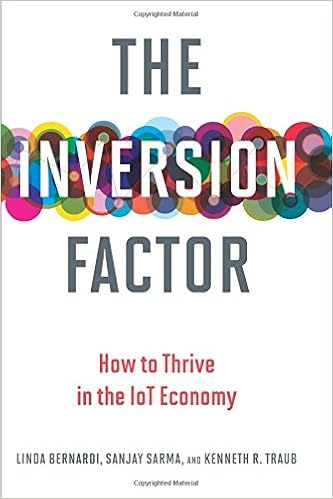
Why companies need to move away from a “product first” orientation to pursuing innovation based on customer need.
In the past, companies found success with a product-first orientation; they made a thing that did a thing. TheInversion Factor explains why the companies of today and tomorrow will have to abandon the product-first orientation. Rather than asking “How do the products we make meet customer needs?” companies should ask “How can technology help us reimagine and fill a need?” Zipcar, for example, instead of developing another vehicle for moving people from point A to point B, reimagined how people interacted with vehicles. Zipcar inverted the traditional car company mission.
The authors explain how the introduction of “smart” objects connected by the Internet of Things signals fundamental changes for business. The IoT, where real and digital coexist, is powering new ways to meet human needs. Companies that know this include giants like Amazon, Airbnb, Uber, Google, Tesla, and Apple, as well as less famous companies like Tile, Visenti, and Augury. The Inversion Factor offers a roadmap for businesses that want to follow in their footsteps.
The authors chart the evolution of three IoTs―the Internet of Things (devices connected to the Internet), the Intelligence of Things (devices that host software applications), and the Innovation of Things (devices that become experiences). Finally, they offer a blueprint for businesses making the transition to inversion and interviews with leaders of major companies and game-changing startups.

“Steve Jobs—not a man inclined to hyperbole when asked about the qualities of others—once described Ed Catmull as ‘very wise,’ ‘very self-aware,’ ‘really thoughtful,’ ‘really, really smart,’ and possessing ‘quiet strength,’ all in a single interview. Any reader of Creativity, Inc., Catmull’s new book on the art of running creative companies, will have to agree. Catmull, president of both Pixar and Walt Disney Animation, has written what just might be the most thoughtful management book ever.”—Fast Company
“It’s one thing to be creative; it’s entirely another—and much more rare—to build a great and creative culture. Over more than thirty years, Ed Catmull has developed methods to root out and destroy the barriers to creativity, to marry creativity to the pursuit of excellence, and, most impressive, to sustain a culture of disciplined creativity during setbacks and success. Pixar’s unrivaled record, and the joy its films have added to our lives, gives his method the most important validation: It works.”—Jim Collins, co-author of Built to Last and author of Good to Great

Innovation in and of itself has no value. It creates value when it results in either sustainable competitive advantage for you, neutralization of a competitor’s competitive advantage, or increased productivity within the status quo. Continue reading
Kelly couldn’t change the nature of the organization, but he could change the nature of the conversation, particularly the beginning of each sentence in the problem- solving process. He didn’t let people start with “We can’t because.” He forced them to start with “We can if.” So, for example, instead of saying “We can’t use that type of new packaging because it will slow the line down,” the person would be forced to say “We can use that kind of new packaging if we run it on someone else’s line.” The flow is maintained, and the group moves on to the next question in the chain (in this case, how to find the right line).

As Kelly notes, “can’t because” is an understandable reaction to a difficult challenge. People are used to putting up their hands to solve a problem they know how to solve; what is much harder, and more unusual, is putting up their hands to solve a problem they don’t know how to solve. And yet that is precisely what is required in constraint-driven problem solving. Without a positive construct to guide the team, the inability to have a ready answer to a difficult question kills the momentum and the flow of exploration. Continue reading
 ONE TUSK