We are shaped by the people who surround us. Our joys are more pleasurable when they are cherished by our friends, our successes more enjoyable when they are applauded by those whose opinions we care about, our protests are less lonely and our indignation less unsure when shared by our supporters, our hatreds more corrosive when goaded by fellow zealots, our sorrows less burdensome when borne with our family.
Transformation
Mental Attitudes Towards Engaging in Action
 The ignorant and the wise are both engaged in action. But their mental attitudes towards action differ greatly. The ignorant person has an obsession for action. He becomes involved in and attached to what he does. He binds himself emotionally to his field of activity. He acts merely to fulfil his egocentric desires. His motive is only personal profit or benefit. He sweats and toils all his life for procuring more comforts and pleasures for himself and perhaps his family. He entertains no other ideal or goal in life. The purpose of his existence does not extend beyond his personal acquisition and indulgence in this world.
Characteristics and Traits that distinguishes a servant leader from the more traditional ones
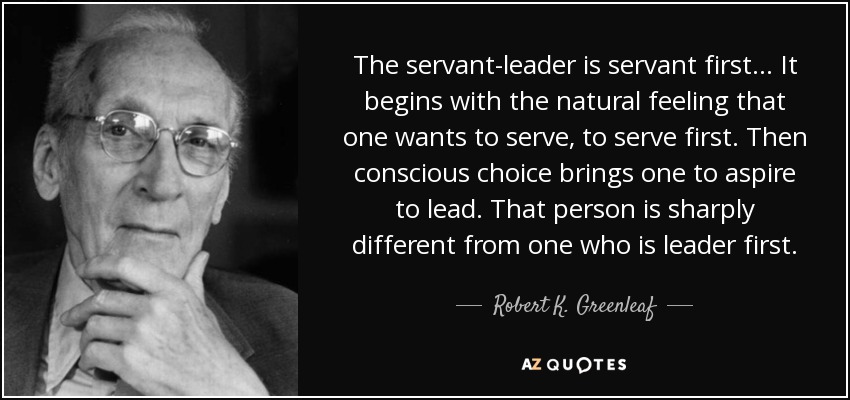 Here are 10 characteristics and traits that distinguishes a servant leader from the more traditional ones.
1. Empathy
A servant leader has the ability to recognize and understand feelings and emotions that are experienced by their team. Such a leader will care for other people and will deeply experience emotions that match what others are feeling. Since they understand others so deeply, their actions are motivated by a genuine desire to help others.
2. Listening
By paying complete attention to what others are saying, servant leaders are able to get a complete understanding of all interpersonal situations that they are dealing with. They use active listening to resolve conflicts, counsel others, and also to impart training.
3. Awareness
Many people in positions of power are blissfully ignorant of their shortcomings, but not the servant leader. They are completely aware of their strengths, weaknesses, values, emotions, and feelings. This self-awareness allows the servant leader to understand personal biases and set them aside while making decisions.
4. Healing
Followers typically desire for a leader who has a sincere interest in fostering their emotional and spiritual well-being. By taking an active role in promoting the mental and emotional strength of their employees, servant leaders typically inspire an exceptional level of trust and faith from others. Continue reading
Warren Buffet – Principle Centred Money Maker
( Contributed by Prem)
Guru has become a four letter word…..
Once it happened…A customer walking into Shankaran Pillai’s pharmacy saw a man outside hugging a lamppost, his eyeballs rolling wildly. When he walked in, he asked, “Who’s that man? What’s wrong with him?” Shankaran Pillai replied, unperturbed, “Oh, that guy. He’s one of my customers.” “But what’s the matter with him?” “He wanted something for a whooping cough. I gave him the appropriate medicine.” “What did you give him?” “A box of laxatives.
what does it means to be a visionary and a volunteer?
life situations can serve as signals to alert us to an imminent transition…..
 Each of us lives in a world, and that world is meant to dry up in its time like a withering flower to make way for the growth that follows it. Lacking an understanding of the process, we are depressed and discouraged when it happens. We say that things aren’t going well for us. We look for ways to solve our problems, fix things, and get our lives back on track again. Of course, “back on track” means “back on the track they were on before we encountered this difficulty.” And that means “back into the life that it was actually time to let go of.”
Far more important than what you are listening to is the act of listening itself
 True listening is another way of bringing stillness into the relationship. When you truly listen to someone, the dimension of stillness arises and becomes an essential part of the relationship. But true listening is a rare skill. Usually, the greater part of a person’s attention is taken up by their thinking. At best, they may be evaluating your words or preparing the next thing to say. Or they may not be listening at all, lost in their own thoughts. Continue reading
Correcting oneself is correcting the whole world
Unless a person firmly adheres to the dictum ‘That which deserves to be reformed is my own mind,’ by turning Selfwards and correcting himself, his mind will get defiled more and more by paying attention exclusively to the defects of others….
 ONE TUSK