Using data from the Harvard study, two researchers showed in 2001 that we can control seven big investment decisions pretty directly: smoking, drinking, body weight, exercise, emotional resilience, education, and relationships. Here’s what you can do about each of them today to make sure your accounts are as full as possible when you reach your later years:
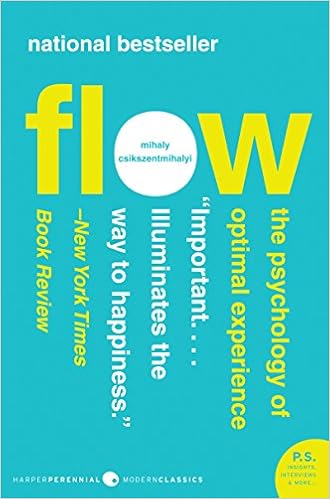
Psychologist Mihaly Csikszentmihalyi’s famous investigations of “optimal experience” have revealed that what makes an experience genuinely satisfying is a state of consciousness called flow. During flow, people typically experience deep enjoyment, creativity, and a total involvement with life. In this new edition of his groundbreaking classic work, Csikszentmihalyi demonstrates the ways this positive state can be controlled, not just left to chance. Flow: The Psychology of Optimal Experience teaches how, by ordering the information that enters our consciousness, we can discover true happiness and greatly improve the quality of our lives.
“You cannot catch hold of it, nor can you get rid of it. In not being able to get it, you get it. When you speak it is silent. When you are silent it speaks.”
“The day my mother died I wrote in my journal, “A serious misfortune of my life has arrived.” I suffered for more than one year after the passing away of my mother. But one night, in the highlands of Vietnam, I was sleeping in the hut in my hermitage. I dreamed of my mother. I saw myself sitting with her, and we were having a wonderful talk. She looked young and beautiful, her hair flowing down. It was so pleasant to sit there and talk to her as if she had never died. When I woke up it was about two in the morning, and I felt very strongly that I had never lost my mother. The impression that my mother was still with me was very clear. I understood then that the idea of having lost my mother was just an idea. It was obvious in that moment that my mother is always alive in me.
When was the last time you made the time to be silent and still? When was the last time you carved out a chunk of time to enjoy the power of solitude to restore, refocus and revitalize your mind, body and spirit?
All of the great wisdom traditions of the world have arrived at the same conclusion: to reconnect with who you really are as a person and to come to know the glory that rests within you, you must find the time to be silent on a regular basis. Sure, you are busy. But as Thoreau said: “It is not enough to be busy, so are the ants. The question is what are you so busy about?”
The importance of silence makes me think about the story of an old lighthouse keeper. The man had only a limited amount of oil to keep his beacon lit so that passing ships could avoid the rocky shores. One night, a man who lived close by needed to borrow some of this precious commodity to light his home, so the lighthouse keeper gave him some of his own. Another night, a traveler begged for some oil to light his lamp so he could keep on travelling. The lighthouse keeper also complied with this request and gave him the amount he needed. The next night, the lighthouse keeper was awakened by a mother banging on his door. She prayed for some oil so that she could illuminate her home and feed her family. Again he agreed. Soon all his oil was gone and his beacon went out. Many ships ran aground and many lives were lost because the lighthouse keeper forgot to focus on his priority. He neglected his primary duty and paid a high price.
Experiencing solitude, for even a few minutes a day, will keep you centered on your highest life priorities and help you avoid the neglect that pervades the lives of so many of us. And saying that you don’t have enough time to be silent on a regular basis is a lot like saying you are too busy driving to stop for gas – eventually it will catch up with you.
Early in my career, as part of my effort to understand how our emotions affect heart health, I trained as a psychotherapist. I discovered then that our heart is indeed much more than a pump.
We all know the sayings, “you touched my heart,” “you stole my heart,” and “my heart is broken.” The heart is the only organ in the body that carries such emotionally charged meaning. But more importantly, these sayings are not simply images; they can describe real, physical, medical events in the heart. The “heavy heart” that comes with sadness, for example, can actually lead to chest pain.
Our emotions and our stresses are far bigger risk factors for heart disease than we acknowledge them to be. When stressed, the body floods itself with the hormones cortisol and adrenaline. Over time, an overdose of these hormones can lead to symptoms such as heart palpitations, ulcers, stroke, or heart attack. So, although we may tell ourselves that we are not as upset as we think we are, our emotions show themselves in other ways.
Simply put, the body never lies. Do not neglect the emotional risk factors for heart disease. How can you reduce such stressors? Here are 15 ways to keep emotions from putting your heart at risk.
Explore Your Anger. Anger is the Achilles’ heel of the cardiovascular system—a trigger for serious problems, including a heart attack. Your blood vessels constrict and your blood pressure rises. The electrical currents to your heart become unstable. And if you have arterial plaque, anger is like throwing a match into a can of gasoline. The plaque can rupture, and the resulting clots can kill you.
One of the best ways to keep anger from becoming a risk factor for heart disease is to release it. Find a place of solitude and scream, yell, or cry. Talk to a friend or visit a skilled psychotherapist to work on your anger. Or, try twisting towels, hitting tennis balls, or punching pillows. It also helps to ask yourself why you feel angry. Recognize that you cannot be effective when you are possessed by anger. If you understand why you’re coming to such an emotional point, you’ll be better able to identify and avoid those triggers……….
Q: What are the key modes of thinking that drive our values and beliefs?
[Adam Grant]: Two decades ago, I read a brilliant paper by Phil Tetlock, who introduced me to this idea of thinking like a preacher, a prosecutor or a politician. Once I’d gotten that framework into my head, I couldn’t let it go. I saw it everywhere… I saw it in my own thinking… in other people’s thinking… I saw it in the way we communicate.
The basic idea is that when you’re preaching, you’re trying to proselytise to other people and defend your sacred beliefs. When you’re prosecuting, you’re trying to win an argument which means you’re going to have to prove the other side wrong. My big worry is when we’re locked into a preacher or prosecutor mindset, we’re not willing to question our own assumptions and opinions… if I’m right, and you’re wrong, then I get to stand still, and you are the one who needs to change. In politicianmode, things are a little more flexible. In that mode, I’m trying to win the approval of an audience – and that means I’m going to lobby or campaign. I might say things you want to hear, but I might not be actually changing what I really think or- if I do- I might be doing it to appease my tribe rather than to find the truth.




 ONE TUSK