Rethinking Your position

Celebrated organizational psychologist and author Adam Grant provides compelling insight into why we should spend time not just thinking, but rethinking. In this episode we cover how to change our own views, how to change the views of others, hiring processes, psychological safety, tribes and group identity, feigned knowledge, binary bias, and so much more.

Grant is a Professor of Psychology at The Wharton School of the University of Pennsylvania and the author of five books, including his most recent release, the New York Times bestseller Think Again. He also serves as the host of WorkLife, a TED original podcast.

University of Unlearning

“`German scholar: I have come to learn from you.

Sri Ramana Maharshi – Venkataraman Iyer.
Born – December 30, 1879, India
Died – April 14, 1950. Tamil Nadu, South India.

Sri Ramana Maharshi said, ‘then you go elsewhere, because here we teach unlearning. Learning is not our way. You go elsewhere. If you are ready to unlearn, be here. If you have come to learn more, then this is not the right place. Then go somewhere else – universities exist for learning. When you come to me, come to unlearn. This is a university for unlearning, university to create no-mind, a university where whatsoever you know will be taken away. All your knowledge has to be dropped so that you become knowing, so you get a perfection, a clarity, so that your eyes are not filled with theses, or theories, with prejudices, concepts; so your eyes have a clarity, an absolute clarity and transparency, so that you can see. The truth is already there. It has always been there.“`

(Contributed by Mr. Balasunder)

Have Strong Faith yet Confront facts of your Current Reality

Now, you might be wondering, “How do you motivate people with brutal facts? Doesn’t motivation flow chiefly from a compelling vision?” The answer, surprisingly, is, “No.” Not because vision is unimportant, but because expending energy trying to motivate people is largely a waste of time. One of the dominant themes that runs throughout this book is that if you successfully implement its findings, you will not need to spend time and energy “motivating” people. If you have the right people on the bus, they will be self-motivated. The real question then becomes: How do you manage in such a way as not to de-motivate people?And one of the single most de-motivating actions you can take is to hold out false hopes, soon to be swept away by events. 

Yes, leadership is about vision. But leadership is equally about creating a climate where the truth is heard and the brutal facts confronted. There’s a huge difference between the opportunity to “have your say” and the opportunity to be heard. The good-to-great leaders understood this distinction, creating a culture wherein people had a tremendous opportunity to be heard and, ultimately, for the truth to be heard.

-Jim Collins from Good to Great

Continue reading

Play the Battle Drums – Buddha

A king had many elephants, but one elephant was very powerful, very obedient, sensible and skillful in everything especially his fighting skills. In many wars, he was sent on the battlefield and he used to return only after getting victory for the king. Therefore, he was the most loved elephant of the king.

Time went by and there came a time when the elephant started getting old. Now he was not able to perform as before. Therefore, the king did not even send him to the battlefield but he still remained as a part of the king’s team.

One day the elephant went to a lake to drink water, but unfortunately his feet got stuck in the mud and he went on sinking. He tried a lot, but he could not remove himself from the mud. People came to know from the sound of his screams that the elephant was in trouble. The news of the elephant trapped also reached the king. All the people, including the king, gathered around the elephant and made various efforts to get him out. But alas, even after trying for a long time, there was no way out. 

Continue reading

What they have and what they do are secondary to what they are….

Mother Teresa
Mother Teresa (1910-1997)

Mother Teresa’s greatness and power arose because she addressed the most noble qualities within human nature—unconditional love and nonjudgmental compassion.

When someone dedicates their life to carrying out the principle of universal truth, that person becomes magnetic. They develop the power of attraction. What they have and what they do are secondary to what they are. It is that quality, which the world acknowledges and brings them, that we term success.

What was it that Mother Teresa acknowledged in others and, by so doing, magnificently brought forth for all of us to see in her? When she ministered to the poor and the sick and the dying in the streets of Kolkata, was she trying to save them from death? Was she trying to raise funds for the poor? No. What she ministered to and acknowledged was the intrinsic truth of human dignity, worth, value, nobility, lovability, and greatness. Those qualities are intrinsic in every human being no matter how abysmal their external life situation may seem to be.

The Map of Consciousness Explained: A Proven Energy Scale to Actualize Your Ultimate Potential by David R. Hawkins

Essence of Karma Yoga

There are two aspects to any action. The first is to perform the action efficiently, perfectly. However perfectly an action may be performed there is always room for improvement. Hence the saying, ‘The largest room in the world is the room for improvement!’ The second aspect is the attitude with which the action is performed. Perfection in action is rather difficult but perfection in attitude is possible. If we perform actions with the right attitude, then however small or big the action, it will become great.  This is beautifully illustrated by the famous squirrel in the Ramayana, who out of love for Sri Rama tried to help the monkeys build the bridge across the ocean. The squirrel first wet itself in the water, then rolled in the sand and shook off the grains of sand on the bridge. This irritated the monkeys but Sri Rama understood the squirrel’s desire to assist in this great endeavour.

So only right actions (performing one’s obligatory duties) performed with the right attitude can be termed as karma yoga; otherwise it is merely karma, action.

-Swami Chinmayananda

relinquish the desire to be ‘right’ or of imaginary value to society…

With humility comes the willingness to stop trying to control or change other people or life situations or events ostensibly ‘for their own good’. To be a committed spiritual seeker, it is necessary to relinquish the desire to be ‘right’ or of imaginary value to society. In fact, nobody’s ego or belief systems is of any value to society at all. The world is neither good nor bad nor defective, nor is it in need of help or modification because its appearance is only a projection of one’s own mind. No such world exists.

– David Hawkins, The Eye of the I: From Which Nothing is Hidden

Book of the Month – April 2021- Think Again by Adam Grant

Think Again: The Power of Knowing What You Don't Know

Progress is impossible without change; and those who cannot change their minds cannot change anything.

-George Bernard Shaw

The bestselling author of Give and Take and Originals examines the critical art of rethinking: learning to question your opinions and open other people’s minds, which can position you for excellence at work and wisdom in life

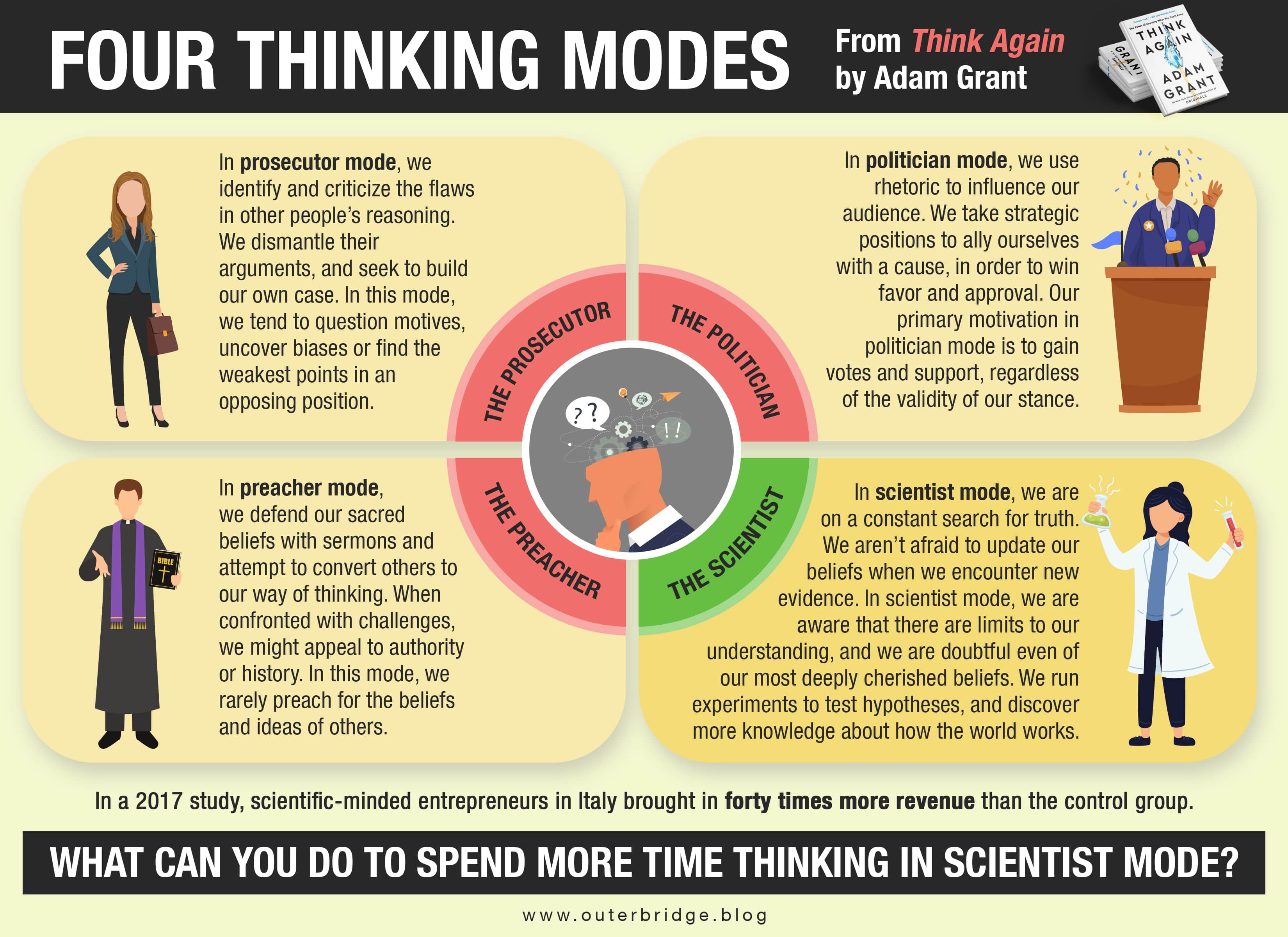
Intelligence is usually seen as the ability to think and learn, but in a rapidly changing world, there’s another set of cognitive skills that might matter more: the ability to rethink and unlearn. In our daily lives, too many of us favor the comfort of conviction over the discomfort of doubt. We listen to opinions that make us feel good, instead of ideas that make us think hard. We see disagreement as a threat to our egos, rather than an opportunity to learn. We surround ourselves with people who agree with our conclusions, when we should be gravitating toward those who challenge our thought process. The result is that our beliefs get brittle long before our bones. We think too much like preachers defending our sacred beliefs, prosecutors proving the other side wrong, and politicians campaigning for approval–and too little like scientists searching for truth. Intelligence is no cure, and it can even be a curse: being good at thinking can make us worse at rethinking. The brighter we are, the blinder to our own limitations we can become.

Organizational psychologist Adam Grant is an expert on opening other people’s minds–and our own. As Wharton’s top-rated professor and the bestselling author of Originals and Give and Take, he makes it one of his guiding principles to argue like he’s right but listen like he’s wrong. With bold ideas and rigorous evidence, he investigates how we can embrace the joy of being wrong, bring nuance to charged conversations, and build schools, workplaces, and communities of lifelong learners. You’ll learn how an international debate champion wins arguments, a Black musician persuades white supremacists to abandon hate, a vaccine whisperer convinces concerned parents to immunize their children, and Adam has coaxed Yankees fans to root for the Red Sox. Think Again reveals that we don’t have to believe everything we think or internalize everything we feel. It’s an invitation to let go of views that are no longer serving us well and prize mental flexibility over foolish consistency. If knowledge is power, knowing what we don’t know is wisdom.

Continue reading