
Thought for the Week – 9th October 2017
(Contributed by Kerry Roxburgh)
Born on the northeast coast of England, of Viking and Welsh ancestry, I grew up as a granddaughter of the Empire and daughter of the Commonwealth. As a young girl in the years following the First World War, I puzzled and then grieved that the men came back so hurt—legs lost, difficulty breathing––and so many dead. How could we have done this? I wondered. Why couldn’t we have talked it through? This was a question that really mattered to me.
Later, studying the armistice conditions ending the war, it became very clear that the lack of ongoing and authentic dialogue among nations created conditions for future conflict. I determined that, when I grew up, I would study ways in which these mistakes would not be repeated.
But then, instead of peace, World War II came, and I spent almost five years in the Royal Air Force. The overarching mission was simple: survive, defeat Nazism, end holocausts, and make the world safe for democracy. In the course of wartime, I lost friends, comrades, and home. One searing experience in Europe, in which I encountered ambulatory Jews being brought out of the camps, caused me to ask my commanding officer: Sir, how could we have done this? He snapped that of course, we had not done this, they had. Yet I knew that, somehow, our human community as a whole had failed in the face of these atrocities.
In my contemplation and study of these questions, it became clear to me that every societal change process I knew of started with an informal conversation in which men and women—young or old—were witnessed and “heard into speech,” sharing their dreams and hopes for making a difference around something they cared about. In being truly seen and heard, people discovered their mutual commitment to act and were transformed.

HBR: You’ve remarked that the Dalai Lama is a very distinctive kind of leader. Is there something we could learn from his unique form of leadership, as leaders ourselves?
Daniel Goleman: Observing him over the years, and then doing this book for which I interviewed him extensively, and of course being immersed in leadership literature myself, three things struck me. Continue reading
While playing on a hot summer day, two young children notice a dripping garden hose. The drop-by-drop trickle provides them with a desire for a real thirst-quenching gulp. But as they grab the hose from one another they feel the lack of real fulfilment.
They spend all their time  rather than using their creativity to follow the hose to its source and turn on the faucet. Continue reading
 “It is wrong to demand that the individual subordinate himself to the collectivity or merge in it because it is by its most advanced individuals that the collectivity progresses and they can really advance only if they are free. But it is true that as the individual advances spiritually, he finds himself more and more united with the collectivity and All.” Continue reading
( Contributed by Karen)
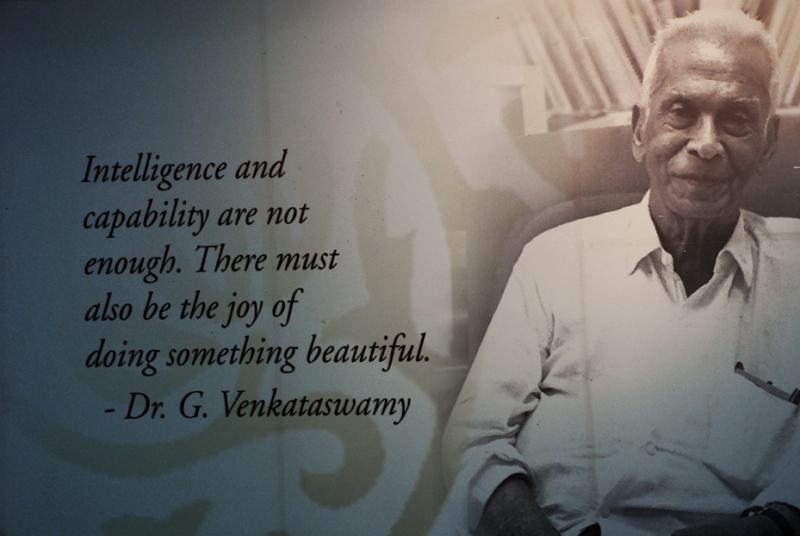 Dr. Govindappa Venkataswamy, founder of Aravind Eye Care Hospital.
Practice for perfect vision. This in essence was what Dr. V always returned to. He believed that the evolution of an organization ultimately hinges on the evolution of the individuals within it. Continue reading
 Why is it that certain people seem to naturally inspire confidence, loyalty, and hard work, while others (who may have just as much vision and smarts) stumble, again and again? It’s a timeless question, and there’s no simple answer. Continue reading
 ONE TUSK