Thought of the Week – 11th August 2025
The experience of the three crises ( Credit, Covid and Climate) of the 21st century, suggests that the common values and beliefs that underpin a successful economy are:
– dynamism to help create solutions and channel human creativity;
– resilience to make it easier to bounce back from shocks while protecting the most vulnerable in society;
– sustainability with long-term perspectives that align incentives across generations; – fairness, particularly in markets to sustain their legitimacy;
– responsibility so that individuals feel accountable for their actions;
– solidarity whereby citizens recognise their obligations to each other and share a sense of community and society;
and
– humility to recognise the limits of our knowledge, understanding and power so that we act as custodians seeking to improve the common good.

Value(s): Building a Better World for All by Mark Carney
Q: What are the key modes of thinking that drive our values and beliefs?
[Adam Grant]: Two decades ago, I read a brilliant paper by Phil Tetlock, who introduced me to this idea of thinking like a preacher, a prosecutor or a politician. Once I’d gotten that framework into my head, I couldn’t let it go. I saw it everywhere… I saw it in my own thinking… in other people’s thinking… I saw it in the way we communicate.
The basic idea is that when you’re preaching, you’re trying to proselytise to other people and defend your sacred beliefs. When you’re prosecuting, you’re trying to win an argument which means you’re going to have to prove the other side wrong. My big worry is when we’re locked into a preacher or prosecutor mindset, we’re not willing to question our own assumptions and opinions… if I’m right, and you’re wrong, then I get to stand still, and you are the one who needs to change. In politicianmode, things are a little more flexible. In that mode, I’m trying to win the approval of an audience – and that means I’m going to lobby or campaign. I might say things you want to hear, but I might not be actually changing what I really think or- if I do- I might be doing it to appease my tribe rather than to find the truth.
Continue reading
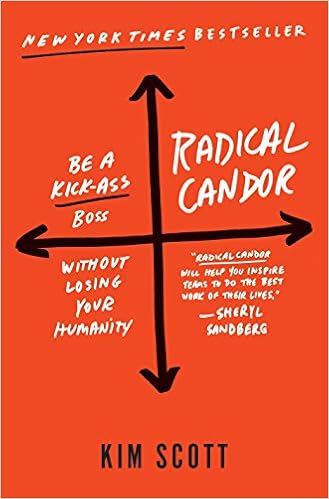 From the time we learn to speak, we’re told that if you don’t have anything nice to say, don’t say anything at all. When you become a manager, it’s your job to say it–and your obligation.
Author Kim Scott was an executive at Google and then at Apple, where she worked with a team to develop a class on how to be a good boss. She has earned growing fame in recent years with her vital new approach to effective management, Radical Candor.
Radical Candor is a simple idea: to be a good boss, you have to Care Personally at the same time that you Challenge Directly. When you challenge without caring it’s obnoxious aggression; when you care without challenging it’s ruinous empathy. When you do neither it’s manipulative insincerity.
This simple framework can help you build better relationships at work, and fulfill your three key responsibilities as a leader: creating a culture of feedback (praise and criticism), building a cohesive team, and achieving results you’re all proud of.
Radical Candor offers a guide to those bewildered or exhausted by management, written for bosses and those who manage bosses. Taken from years of the author’s experience, and distilled clearly giving actionable lessons to the reader; it shows managers how to be successful while retaining their humanity, finding meaning in their job, and creating an environment where people both love their work and their colleagues.
( Recommended by Fanny Limare-Wolf) Continue reading
The potent force that shapes behavior in these organizations and in all natural systems is the combination of simply expressed expectations of purpose, intent, and values, and the freedom for responsible individuals to make sense of these in their own way. Continue reading
In this chaotic world, we need leaders. But we don’t need bosses. We need leaders to help us develop the clear identity that lights the dark moments of confusion. We need leaders to support us as we learn how to live by our values. We need leaders to understand that we are best controlled by concepts that invite our participation, not policies and procedures that curtail our contribution. Continue reading
Like it or not, we are viewed as boorish, charmless winners whose snarling sledges, send-offs and generally ugly behaviour say more about us than our record of prolonged success.
Mike Walters in The Daily Mirror was strident in his criticism of the Aussies’ on-field chat, juxtaposed so neatly by the sportsmanship and classy touches shown by our New Zealand rivals.
“One conspicuous difference between mother country and champions has not escaped international attention: Boring, boring England were useless but boorish, boorish Australia were not above criticism.
“Not for the first time, when the conquerors’ mask slipped, Straya could not resist the temptation to underline their superiority with gloating send-offs, even in a one-sided final where New Zealand never got out of the blocks.

The eyes have it. Grant Elliott’s intense stare at Brad Haddin tell its own story.Source: News Corp Australia
“When Martin Guptill was bowled by Glenn Maxwell, wicketkeeper Brad Haddin appeared to taunt him by clapping in his face like a performing seal.
“Contrast the fate of Black Caps top scorer Grant Elliott, serenaded with verbals on his dismissal, with four New Zealand players lining up to shake Australian captain Michael Clarke’s hand when he was out just eight runs short of the chequered flag.”
It’s clear Haddin’s antics didn’t go down too well across the ditch, if this image of the Dominion Post’s front page is anything to go by.
 ONE TUSK