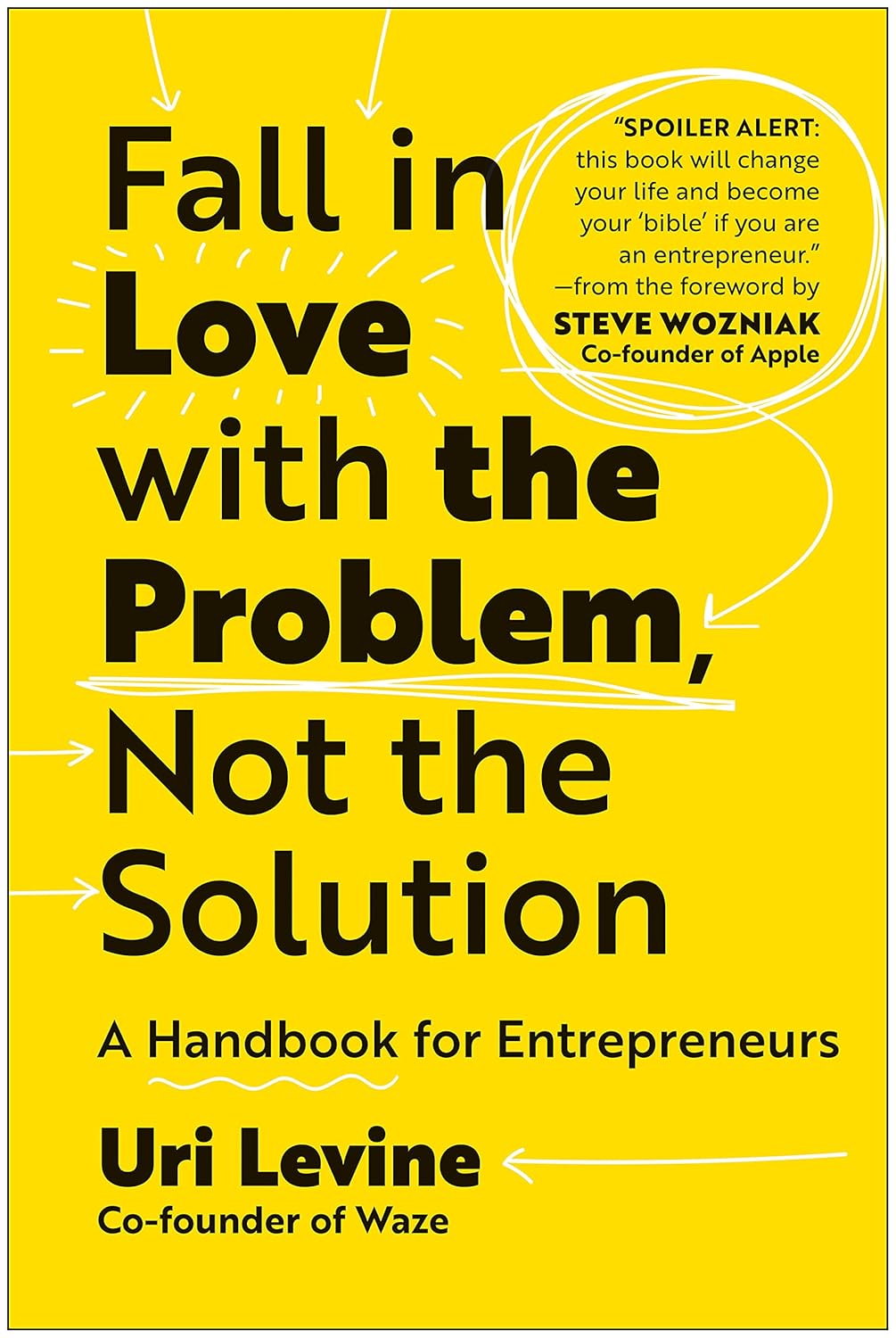
Book of the Month – June 2024: Fall in Love with the Problem, not the Solution by Uri Levine

Unicorns—companies that reach a valuation of more than $1 billion—are rare. Uri Levine has built two.

And in Fall in Love with the Problem, Not the Solution, he shows you just how he did it.

As the cofounder of Waze—the world’s leading commuting and navigation app with more than 700 million users to date, and which Google acquired in 2013 for $1.15 billion—Levine is committed to spreading entrepreneurial thinking so that other founders, managers, and employees in the tech space can build their own highly valued companies.

Levine offers an inside look at the creation and sale of Waze and his second unicorn, Moovit, revealing the formula that drove those companies to compete with industry veterans and giants alike. He offers tips on:

  • Firing and hiring
  • Disrupting “broken” markets
  • Raising funding
  • Understanding your users
  • Reaching product market fit
  • Making scale-up decisions
  • Going global
  • Deciding when to sell

Fall in Love with the Problem, Not the Solution offers mentorship in a book from one of the world’s most successful entrepreneurs, and empowers you to build a successful business by identifying your consumers’ biggest problems and disrupting the inefficient markets that currently serve them.

Continue reading
Book Recommendation – The Inversion Factor: How to Thrive in the IoT Economy

Why companies need to move away from a “product first” orientation to pursuing innovation based on customer need.

In the past, companies found success with a product-first orientation; they made a thing that did a thing. TheInversion Factor explains why the companies of today and tomorrow will have to abandon the product-first orientation. Rather than asking “How do the products we make meet customer needs?” companies should ask “How can technology help us reimagine and fill a need?” Zipcar, for example, instead of developing another vehicle for moving people from point A to point B, reimagined how people interacted with vehicles. Zipcar inverted the traditional car company mission.

The authors explain how the introduction of “smart” objects connected by the Internet of Things signals fundamental changes for business. The IoT, where real and digital coexist, is powering new ways to meet human needs. Companies that know this include giants like Amazon, Airbnb, Uber, Google, Tesla, and Apple, as well as less famous companies like Tile, Visenti, and Augury. The Inversion Factor offers a roadmap for businesses that want to follow in their footsteps.

The authors chart the evolution of three IoTs―the Internet of Things (devices connected to the Internet), the Intelligence of Things (devices that host software applications), and the Innovation of Things (devices that become experiences). Finally, they offer a blueprint for businesses making the transition to inversion and interviews with leaders of major companies and game-changing startups.

http://a.co/d/6ymCHof