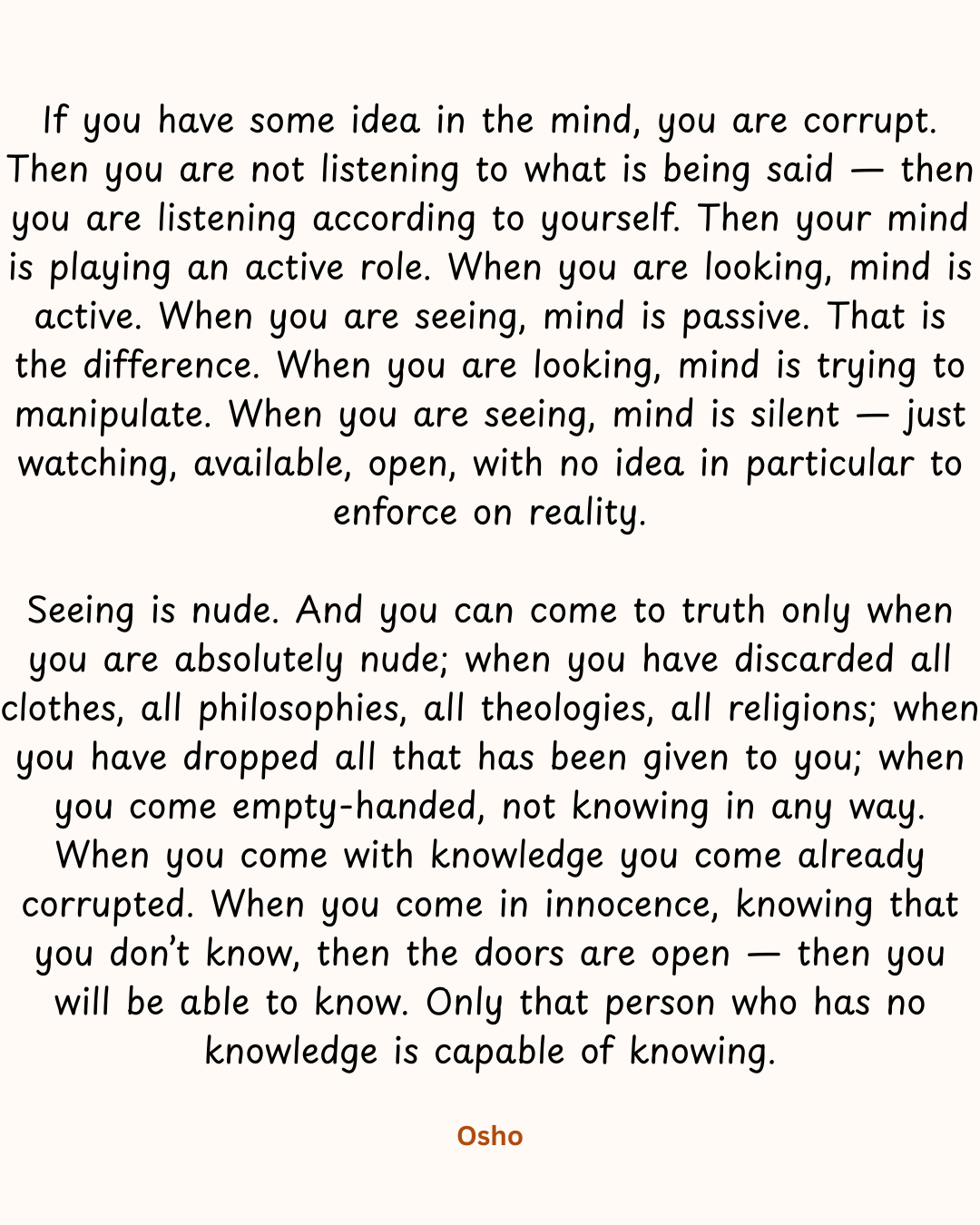
In meditation there is no conclusion behind it. You are not doing anything in particular, you are simply being. It has no past to it, it is uncontaminated by the past. It has no future to it, it is pure of all future. It is what Lao Tzu has called wei-wu-wei, action through inaction. This is what Zen masters have been saying: “Sitting silently doing nothing, the spring comes and the grass grows by itself.” Remember, “by itself” – nothing is being done. You are not pulling the grass upward; the spring comes and the grass grows by itself. That state – when you allow life to go on its own way, when you don’t want to direct it, when you don’t want to give any control to it, when you are not manipulating, when you are not enforcing any discipline on it – that state of pure undisciplined spontaneity is what meditation is.
–Osho from The Heart Sutra: Becoming a Buddha through Meditation
Journaling is impactful because it creates a unique space where multiple powerful psychological processes converge:
It externalises internal chaos. The simple act of moving thoughts from your mind to paper transforms abstract worries into manageable, concrete problems. This shift from internal rumination to external observation gives you psychological distance and clarity you can’t achieve through thinking alone.
It activates neuroplasticity (brain’s ability to change and adapt due to experience). Writing engages both analytical and creative brain regions simultaneously, literally rewiring neural pathways. The physical act of writing (especially by hand) strengthens memory formation and emotional processing in ways that typing or just thinking cannot match.
It breaks the illusion of permanence. When you write down fears, anger, or confusion, you often discover they’re more temporary and changeable than they felt in your head. Seeing “I’m terrible at everything” on paper reveals its absurdity in a way that thinking it doesn’t.
It creates a witness to your life. Journaling makes you both the observer and the observed, developing a kind of compassionate self-awareness. You begin treating yourself with the same curiosity and kindness you’d show a friend telling you their story.
It builds emotional resilience. Regular journaling literally practices the skill of processing difficult emotions. Each time you write through pain, confusion, or challenge, you strengthen your capacity to handle future difficulties.
It reveals your authentic voice. Without audience or judgment, your true thoughts, values, and desires emerge. Many people discover who they really are through journaling, separate from who they think they should be.
It creates forward momentum. Writing clarifies not just what is, but what could be, naturally leading to insights about next steps and positive change.
“The most important thing you learn from writing is about yourself.” — Ray Bradbury
So, returning to a critical question, what makes a person resilient to Alzheimer’s? One factor is referred to as “cognitive reserve,” … The greater the amount of knowledge one has amassed and learned, for example through higher education, the greater the number of synapses in one’s brain. Since the degree of dementia in Alzheimer’s patients correlates most closely with loss of synapses, the more synapses you have, the more you can lose before problems set in. Thus, continuing to learn new things is very important as we age. When planning for your retirement, think just as much about your cognitive reserve as about your financial reserve.
The following recommendations have been shown to have the most useful effects on risk reduction—you’ll recognize them from our general advice for a healing lifestyle, although they are more specific here:
Your long search for a simple book on meditation ends here!
I am inspired to write this because this book is a gem and shouldn’t go unnoticed by any sincere seeker. I really loved the simplicity of this book in explaining an esoteric subject as meditation. Every concept of the heartfulness meditation practice, its tips and tricks are spread out in simple terms before the reader by this loving guide without any secrets being held back as was the tradition in ancient Guru-disciple relationship. I have been meditating for a few years now and I should say that I learned a lot of minute details from this book which I was not aware of but which could improve my practice manifold. The examples given here are also very practical that we can easily relate to and hence flows seamlessly from start to end. Overall, a must read for anyone contemplating meditation, a good starting point for beginners and also a great tool to move ahead for pros. Thank you for this wonderful book!





 ONE TUSK