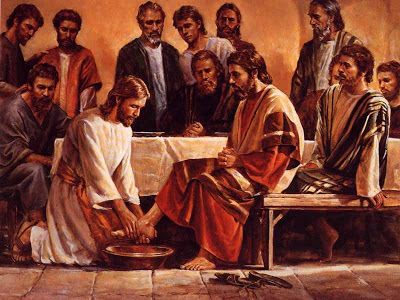
 “Who was the greatest: He who made the worlds or He who washed His disciples’ feet?”
– Edgar Cayce
“Who was the greatest: He who made the worlds or He who washed His disciples’ feet?”
– Edgar Cayce
 So long as there is the sense of separation, there will be afflicting thoughts. If the original source is regained and the sense of separation is ended, there is peace.
Consider what happens when a stone is thrown up. It leaves its source, is propelled up, tries to come down and is always in motion until it regains its source where it is at rest.
So also the waters of the ocean evaporate, form clouds which are moved by winds, condense into water, and fall as rain, and the waters roll down the hill tops in streams and rivers until they reach their original source, the ocean, reaching which they are at peace.
Thus you see where there is a sense of separateness from the source, there is agitation and movement until the sense of separateness is lost. So it is with yourself. Continue reading
Bhairav Nath Shukla has been the Manager of Mukti Bhawan for 44 years. He has seen the rich and the poor take refuge in the guesthouse in their final days as they await death and hope to find peace. Shukla hopes with and for them. He sits on the wooden bench in the courtyard, against the red brick wall and shares with me 12 recurring life lessons from the 12000 deaths he has witnessed in his experience as the manager of Mukti Bhawan: Continue reading
It is said in the texts that 80% of the fighting male population of the civilization was wiped out in the eighteen days Mahabharata war.
Sanjay, at the end of the war went to the spot where the greatest war took place; Kurukshetra.
He looked around and wondered if the war really happened, if the ground beneath him had soaked all that blood, if the great Pandavas and Krishna stood where he stood.
“You will never know the truth about that!” said an aging soft voice.
Sanjay turned around to find an Old man in saffron robes appearing out of a column of dust.
“I know you are here to find out about the Kurukshetra war, but you cannot know about that war till you know what the real war is about.” the Old man said enigmatically.
At the heart of Nhat Hanh’s teachings is the idea that “understanding is love’s other name” — that to love another means to fully understand his or her suffering. (“Suffering” sounds rather dramatic, but in Buddhism it refers to any source of profound dissatisfaction — be it physical or psychoemotional or spiritual.) Understanding, after all, is what everybody needs — but even if we grasp this on a theoretical level, we habitually get too caught in the smallness of our fixations to be able to offer such expansive understanding. He illustrates this mismatch of scales with an apt metaphor:
If you pour a handful of salt into a cup of water, the water becomes undrinkable. But if you pour the salt into a river, people can continue to draw the water to cook, wash, and drink. The river is immense, and it has the capacity to receive, embrace, and transform. When our hearts are small, our understanding and compassion are limited, and we suffer. We can’t accept or tolerate others and their shortcomings, and we demand that they change. But when our hearts expand, these same things don’t make us suffer anymore. We have a lot of understanding and compassion and can embrace others. We accept others as they are, and then they have a chance to transform.
 Faith and determination, these two are the essential rungs on the ladder of enlightenment. Continue reading
 ONE TUSK