A WALL STREET JOURNAL BESTSELLER by DR. JOE DISPENZA , the author of the New York Times bestseller You Are the Placebo, as well as Breaking the Habit of Being Yourself and Evolve Your Brain.
Becoming Supernatural draws on epigenetics, quantum physics & neuroscience research conducted at his advanced workshops since 2012 to explore how common people are doing the uncommon to transform their consciousness, mindset, and beliefs to heal and live SUPERNATURAL lives.
Becoming Supernatural marries some of the most profound scientific information with ancient spiritual wisdom to show how people like you and me can experience a more mystical life.
Readers will learn that we are, quite literally supernatural by nature if given the proper knowledge and instruction, and when we learn how to apply that information through various healing meditations, we should experience a greater expression of our creative abilities.
We have the capacity to tune in to frequencies beyond our material world and receive more orderly coherent streams of consciousness and energy; that we can intentionallychange our brain chemistry to initiate profoundly mystical transcendental experiences; and how, if we do this enough times, we can develop the skill of creating a more efficient, balanced, healthy body, a more unlimited mind, and greater access to the quantum field and the realms of spiritual truth.
Osho, can you speak on the difference between freedom for and freedom from?
Freedom from is ordinary, mundane. Man has always tried to be free from things. It is not creative. It is the negative aspect of freedom. Freedom for is creativity. You have a certain vision that you would like to materialize and you want freedom for it. Freedom from is always from the past, and freedom for is always for the future. Freedom for is a spiritual dimension because you are moving into the unknown and perhaps, one day, into the unknowable. It will give you wings. Freedom from, at the most, can take away your handcuffs. It is not necessarily beneficial—and the whole of history is proof of it. People have never thought of the second freedom that I am insisting on; they have only thought of the first— because they don’t have the insight to see the second. The first is visible: chains on their feet, handcuffs on their hands. They want to be free from them, but then what? What are you going to do with your hands? You may even repent that you asked for freedom from…..
….There are two parts to revolution, from and for; and there should be two kinds of revolutionaries: those who are working for the first—that is freedom from—and those who will work when the work of the first is finished, for freedom for. But it is difficult to manage. Who will manage it?……
….That is why I don’t teach revolution; I teach you rebellion. Revolution is of the crowd; rebellion is of the individual. The individual changes himself.He does not care about the power structure; he simply manages to change his own being, gives birth to a new man in himself. And if the whole country is rebellious…
The seed cannot know what is going to happen, the seed has never known the flower. And the seed cannot even believe that he has the potentiality to become a beautiful flower. Long is the journey, and it is always safer not to go on that journey because unknown is the path, nothing is guaranteed. Nothing can be guaranteed. Thousand and one are the hazards of the journey, many are the pitfalls – and the seed is secure, hidden inside a hard core. But the seed tries, it makes an effort; it drops the hard shell which is its security, it starts moving. Immediately the fight starts: the struggle with the soil, with the stones, with the rocks. And the seed was very hard and the sprout will be very, very soft and dangers will be many. There was no danger for the seed, the seed could have survived for millennia, but for the sprout many are the dangers. But the sprout starts towards the unknown, towards the sun, towards the source of light, not knowing where, not knowing why. Great is the cross to be carried, but a dream possesses the seed and the seed moves. The same is the path for man. It is arduous. Much courage will be needed.
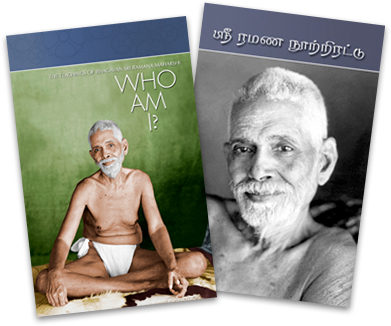
Maalok: Ramana Maharshi has had a lasting influence on your life. For those of us who don’t know much about the Maharshi, could you please share some of the salient aspects of his life that have influenced you deeply.
David: About two or three times a year someone asks me this question, ‘Summarise Ramana Maharshi’s life and teachings in a few words for people who know little or nothing about him’. It’s always hard to know where to start with a question like this.
Let me say first that Ramana Maharshi was one of the most highly regarded and widely respected spiritual figures that twentieth-century India produced. I can’t think of any other candidate who is as persistently held out to be an example of all that is best in the Hindu spiritual tradition. Everyone reveres him as the perfect example of what a true saint and sage ought to be.
How did this come about? While he was still in his teens Sri Ramana underwent a remarkable, spontaneous experience in which his individuality died, leaving him in a state in which he found his true identity to be the Self, the immanent and transcendent substratum. It was a permanent awakening that was truly remarkable because he had not previously had any interest in spiritual matters. He left his family home a few weeks later, without telling anyone where he was going, and spent the remainder of his life at the foot of Arunachala, a holy mountain and pilgrimage centre that is about 120 miles south west of Chennai.
After a few years there – a period in which he was largely oblivious to the world and his body – he began to attract devotees because there was a spiritual radiance emanating from him that many people around him experienced as peace or happiness. This, I think, is the secret of his subsequent fame and popularity. He didn’t get a reputation for being a great sage because of what he did or said. It came about because people, who arrived at his ashram with all kinds of questions and doubts, suddenly found themselves becoming quiet, peaceful and happy in his presence. There was a continuous, benign flow of energy coming off him that somehow evaporated the mental anxieties and busy minds of the people who came to see him. He didn’t ask people to come. People just came of their own accord. A 19th century American author once wrote that if you invent a better mousetrap, even if you try to hide yourself in the woods, people will beat a path to your door. People beat a path to Sri Ramana’s door – for many years he lived in very inaccessible places – because he had something far better than an improved mousetrap to offer; he had a natural ability to induce peace in the people around him.
Let me expand on this because this is the key to understanding both his state and the effect he had on other people. When he had his final experience at the age of sixteen, his mind, his sense of being an individual person, vanished forever, leaving him in a state of unassailable peace. He realised and understood that this was not some new experience that was mediated by and through his ‘I’, his sense of being an individual person. It was, instead, his natural state, something that is there all the time, but which is only experienced when the mind and its perpetual busy-ness is absent. By abiding in this natural and effortless state of inner silence he somehow charged up the atmosphere around him with a healing, quietening energy. People who came to see him spontaneously became happy, peaceful and quiet. Why? Because Sri Ramana himself was effortlessly broadcasting his own experience of happiness, peace and quietude in such a way that those people who were around him got an inner taste, an inner flavor of this natural state that is inherent to all of us. I should say that this power was not restricted to his physical vicinity, although it did seem to be stronger there. People who merely thought about him wherever they happened to be discovered that they could experience something of this peace simply through having this mental contact with him.
So, having given that background, I can now answer the question: ‘Who was Ramana Maharshi and what were his teachings?’
Sri Ramana Maharshi was a living embodiment of peace and happiness and his ‘teachings’ were the emanations of that state which helped other people to find and experience their own inner happiness and peace.
If all this sounds a little abstract, let me tell you a story that was passed on to me by Arthur Osborne’s daughter. In the 1940s their house was a kind of dormitory for all the stray foreigners who couldn’t find anywhere else to stay near Sri Ramana’s ashram. A miserable, crabby women appeared one evening, having been sent by the ashram. They put her up, gave her breakfast and sent her off to see Sri Ramana the next morning. She came back at lunchtime looking absolutely radiant. She was glowing with happiness. The whole family was waiting to hear the story of what happened, but she never said anything about her visit to the ashram. Everyone in the house was expecting some dramatic story: ‘He looked at me and this happened,’ or ‘I asked a question and then I had this great experience’. As the lunch plates were being cleared away, her hosts could not contain their curiosity any longer.
‘What happened?’ asked one of them. ‘What did Bhagavan do to you? What did he say to you?’
The woman looked most surprised. ‘He didn’t do anything. He didn’t say anything to me. I just sat there for the whole morning and then came back for lunch.’
She had been just one new person sitting in a crowd of people, but the power coming off Sri Ramana had been enough to wash away a lifetime of depression, leaving her with a taste of what lay underneath it: her own inherent, natural happiness and peace.
Sri Ramana knew that transformations such as these were going on around him all the time, but he never accepted responsibility for them. He would never say, ‘I transformed this woman’. When he was asked about the effect he was having on people, he would sometimes say that by continuously abiding in his own natural state of peace, a sannidhi, a powerful presence, was somehow created that automatically took care of the mental problems of the people who visited him. By abiding in silence as silence, this energy field was created, a field that miraculously transformed the people around him.
Your original question was, ‘Why has Ramana Maharshi influenced me so much?’ The answer is, ‘I came into his sannidhi and through its catalytic activity I discovered my own peace, my own happiness.’
– David Godman
David Godman has lived in India since 1976, mostly in Tiruvannamalai, Tamil Nadu. He spent his time there studying and practicing the teachings of Sri Ramana Maharshi. His anthology of Ramana
No way to self-realization is short or long, but some people are more in earnest and some are less.
I can tell you about myself.
I was a simple man, but I trusted my Guru. What he told me to do, I did.
He told me to concentrate on ‘I am’
– I did.
He told me that I am beyond all perceivables and conceivables
– I believed.
I gave my heart and soul, my entire attention and the whole of my spare time (I had to work to keep my family alive).
As a result of faith and earnest application, I realized my Self within three years. You may choose any way that suits you; your earnestness will determine the rate of progress.
Establish yourself firmly in the awarenessof ‘I am’.
This is the beginning and also the end of all endeavour.




 ONE TUSK