“When we are concerned with the well-being of other human beings, that inner door opens, and we are able to communicate very easily with other people”
– Archbishop Tutu
– Archbishop Tutu
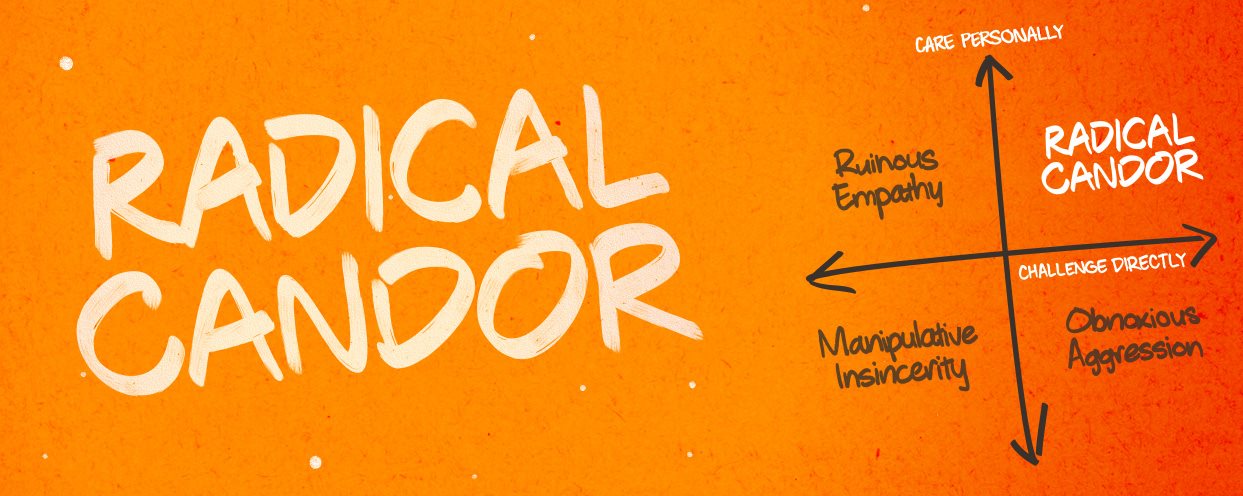
Radical Candor is a simple idea:
To be a good leader, you have to Care Personally at the same time that you Challenge Directly.
When you challenge without caring it’s obnoxious aggression;
When you care without challenging it’s ruinous empathy.
When you do neither it’s manipulative insincerity.
![Radical Candor: Be a Kick-Ass Boss Without Losing Your Humanity by [Scott, Kim]](https://images-na.ssl-images-amazon.com/images/I/411O8D1w2UL.jpg)
 In his 1989 book “On Becoming a Leader,” Warren Bennis composed a list of the differences between managers and leaders:
– The manager administers; the leader innovates.
– The manager is a copy; the leader is an original.
– The manager maintains; the leader develops.
– The manager focuses on systems and structure; the leader focuses on people.
– The manager relies on control; the leader inspires trust.
– The manager has a short-range view; the leader has a long-range perspective.
– The manager asks how and when; the leader asks what and why.
– The manager has his or her eye always on the bottom line; the leader’s eye is on the horizon.
– The manager imitates; the leader originates.
– The manager accepts the status quo; the leader challenges it.
– The manager is the classic good soldier; the leader is his or her own person.
– The manager does things right; the leader does the right thing. Continue reading

Lack of trust. Team members are uncomfortable being vulnerable with one another, unwilling to admit their weaknesses, mistakes or needs for help.
View original post 84 more words
When Anthony Ray Hinton went to death row after a trial that can only be called a travesty of justice, he was understandably angry and heartbroken at how the American justice system had failed him. “When no one believes a word you say, eventually you stop saying anything. I did not say good morning. I did not say good evening. I did not say a how-do-you-do to anyone. If the guards needed some information from me, I wrote it down on a piece of paper. I was angry.
The philosopher Owen Flanagan puts it this way: “We are born into families and communities with an image of persons already in place. We have no say about the location in space of images into which we are born. The image antedates us, often by centuries. . . . Once we reach an age where we do have some control, we work from the image, from the story that is already deeply absorbed, a story line that is already part of our self-image.” We can become stout defenders of that self-image even as it becomes less and less about ourselves and more and more about an externally imposed image….. Continue reading
 To revolt within society in order to make it a little better, to bring about certain reforms, is like the revolt of prisoners to improve their life within the prison walls; and such revolt is no revolt at all, it is just mutiny. Do you see the difference? Revolt within society is like the mutiny of prisoners who want better food, better treatment within the prison; but revolt born of understanding is an individual breaking away from society, and that is creative revolution. Continue reading


 ONE TUSK