Transformation
If you want a good life…..
The story of two Farmers:
Once upon a time,.in a small village lived two poor farmers. They had small piece of land on which they worked hard to take care of their own and their family’s needs.
Suddenly, both of them died on the same day. Yamraj (God of Death) took both of them together to God.
God asked them, ‘What was missing in your life?’
One of the farmers said angrily, ‘You gave me nothing and I lived a very painful life. I had to work in the fields like a bull all my life & whatever I earned had to be spent on just feeding myself & my family. I couldn’t wear good clothes or feed my family good food & whenever I was able to make some extra income, someone would come & take away all. I had nothing left with me.’
After listening to him God again asked, ‘What do you want now? What should I make you in your next life?’
The farmer replied, “God, do something so that I never have to give anything to anyone. I only receive money and things from all sides.’
God said, ‘Ok. You can go now. I will give you the life you have asked for.’
He left.
Now, it was the turn of the other farmer. God asked him, ‘What was missing in your life?’
The farmer, with folded hands said ‘God, You have already given me everything. A good family, some land, plenty of food to eat. I and my family never slept hungry.
There was only one shortcoming in my life which I regretted my whole life & still do today. Sometimes, hungry or thirsty people used to come to my door, to ask for food but I was not able to give them anything as I didn’t have enough to give & they had to return from my door, hungry.’
God asked him, ‘What do you want now? What do you want to be in your next life?’
The farmer pleaded with God, ‘God, do something so that no one will ever go away from my door, thirsty or hungry.’
God said, ‘Ok. You can leave now. You will be given what you asked for.’
Both the farmers were born in the same village on the same day. The farmer who asked only to recieve money from all sides but not give anything to anyone – he became a beggar in the village. Now he didn’t have to give anything to anyone. Anyone who passed by him, used to give him money & things.
Moral: It is often seen that, mostly people always like others’ things more & because of this they are not able to live their life well & are never happy. If you want to live a good life, think good. Do not count just the shortcomings of your life, rather be grateful & enjoy what God has given & serve others, you’ll never lack anything & will ways be happy.
On the other hand, the farmer who didn’t ask God for anything except that there would be never a day when anyone has to leave his house thirsty and hungry – became the richest man of that village.
-Osho
( contributed by Mr Balasunder)
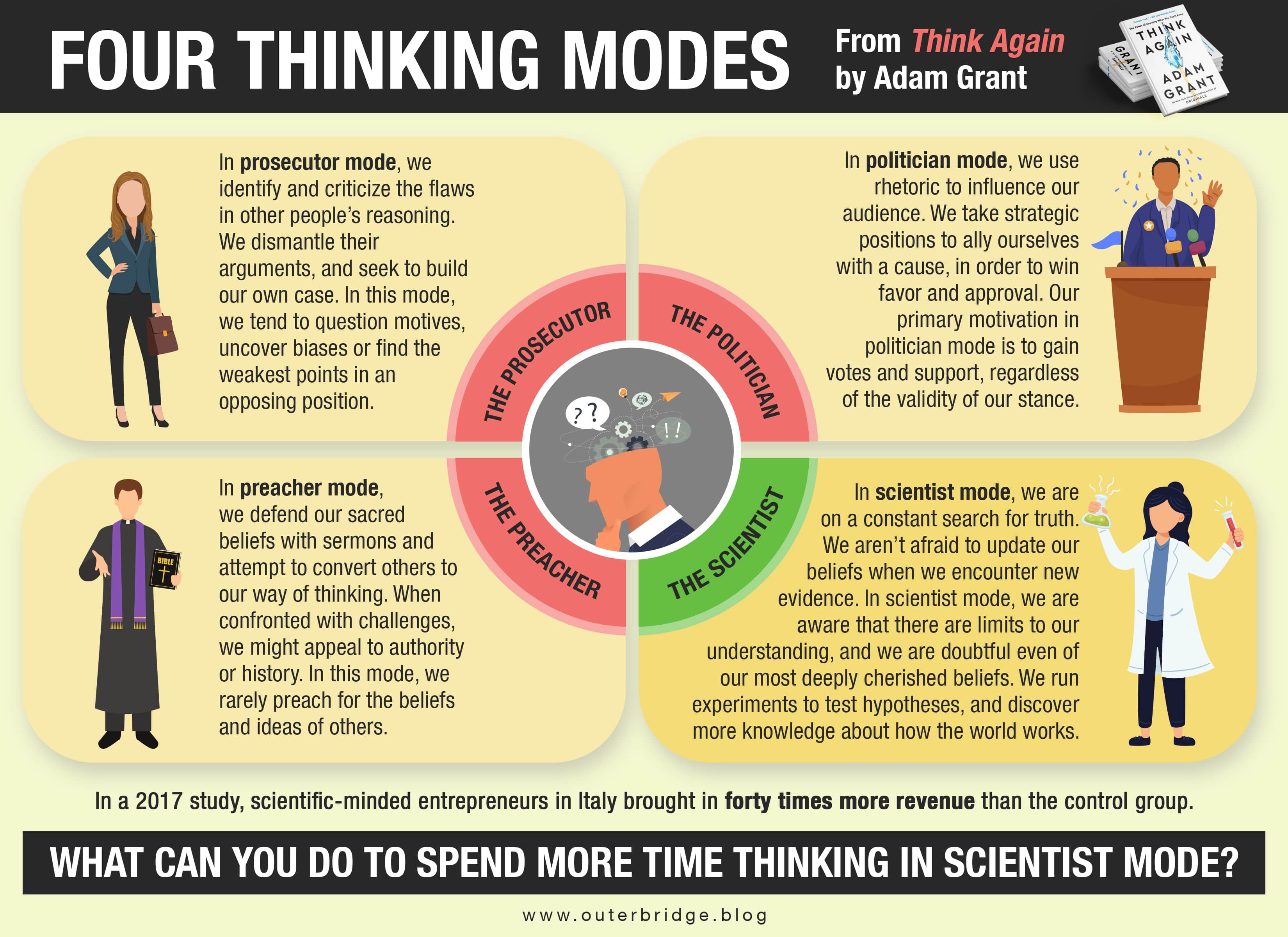
Four Thinking Modes by Adam Grant
| THINK AGAIN — ADAM GRANT4/3/20210 Comments Rating: ★★★★½ Summary: Think Again (Canada/US) explores the power of rethinking in a world where certainty and dogma often spread like wildfire. Much of the time, we hold onto our deeply cherished beliefs and seek out confirming evidence for them. In the process, we settle on beliefs that may be flawed and rarely, if ever, revisit them. When we do so, we act in three main roles: as preachers trying defend our beliefs from questioning, as prosecutors attacking the arguments of the opposition, and as politicians using rhetoric to persuade others to our point of view. However, there is a fourth role that is often neglected: that of a scientist questioning a hypothesis. I co-created an infographic outlining these four modes of thinking. Check it out : |
University of Unlearning
“`German scholar: I have come to learn from you.

Born – December 30, 1879, India
Died – April 14, 1950. Tamil Nadu, South India.
Sri Ramana Maharshi said, ‘then you go elsewhere, because here we teach unlearning. Learning is not our way. You go elsewhere. If you are ready to unlearn, be here. If you have come to learn more, then this is not the right place. Then go somewhere else – universities exist for learning. When you come to me, come to unlearn. This is a university for unlearning, university to create no-mind, a university where whatsoever you know will be taken away. All your knowledge has to be dropped so that you become knowing, so you get a perfection, a clarity, so that your eyes are not filled with theses, or theories, with prejudices, concepts; so your eyes have a clarity, an absolute clarity and transparency, so that you can see. The truth is already there. It has always been there.“`
(Contributed by Mr. Balasunder)
A new consciousness is necessary

A new consciousness and a totally new morality are necessary to bring about a radical change in the present culture and social structure. This is obvious, yet the Left and the Right and the revolutionary seem to disregard it. Any dogma, any formula, any ideology is part of the old consciousness; they are the fabrications of thought whose activity is fragmentation – the Left, the Right, the centre. This activity will inevitably lead to bloodshed of the Right or of the Left or to totalitarianism. This is what is going on around us. One sees the necessity of social, economic, and moral change but the response is from the old consciousness, thought being the principal actor. The mess, the confusion, and the misery that human beings have got into are within the area of the old consciousness, and without changing that profoundly,every human activity – political, economic or religious – will only bring us to the destruction of each other and of the earth. This is so obvious to the sane.
J Krishnamurthi
(Contributed by Mr Balasunder)
Elon Musk’s entrepreneurial success tactics and strategies……
Elon Musk’s entrepreneurial success is a direct result of his mindset, strategies, and intelligence.
Having known Elon for 20 years, I’ve had the opportunity to watch his meteoric rise into someone who is arguably the greatest entrepreneur of our age.
In this blog, I’ll summarize what every exponential entrepreneur can learn and emulate from Elon’s core success tactics and strategies.
I’ve divided these lessons into 6 sections:
- Deep-rooted Passion
- Massively Transformative Purpose
- Singular, Unwavering Focus
- First Principles Thinking
- Thinking in Probabilities
- Not Settling for “No” / Not Giving Up
Let’s dive in…

1. DEEP-ROOTED PASSION
“I didn’t go into the rocket business, the car business, or the solar business thinking, ‘This is a great opportunity.’ I just thought, in order to make a difference, something needed to be done. I wanted to create something substantially better than what came before.” – Elon Musk
Elon only tackles those problems where he has deep-rooted passion and conviction.
After selling PayPal, with $165M in his pocket, he set out to pursue three Moonshots, and subsequently built three multibillion-dollar companies: SpaceX, Tesla, and SolarCity.
This passion (and the underlying emotional drive) allowed him to push forward through extraordinarily difficult times and take big risks.
You might think it was always easy for Elon, but back in 2008 he was at a lowest low: SpaceX had just experienced its third consecutive failure of the Falcon-1 launch vehicle, Tesla was out of money, SolarCity was not getting financed, and Musk was going through a divorce.
He had to borrow money for basic living. Traumatic times.
Despite the 2008 economic crisis at the time, he bet every penny he had, and eventually everything turned around. Going from being in debt, to the wealthiest person on the planet just 13 years later. Wow, what a journey!
Ultimately, it was his passion, refusal to give up, and drive that allowed him to ultimately succeed and begin to impact the world at a significant scale.
2. CLEAR MASSIVELY TRANSFORMATIVE PURPOSE(S)
Part of Elon’s ability to motivate his teams to do great things is his crystal-clear Massively Transformative Purpose (MTP), which drives each of his companies.
As I always say, social movements, rapidly growing organizations, and remarkable breakthroughs in science and technology are all backed by a powerful MTP.
Elon’s MTP for Tesla and SolarCity is to accelerate the world’s transition to sustainable energy.
To this end, every product Tesla brings to market is focused on this vision and backed by a Master Plan he wrote nearly 15 years ago.
Elon’s MTP for SpaceX is to backup the biosphere by making humanity a multi-planet species.
Elon has been preaching this since the founding of SpaceX back in 2002, even when he was experiencing numerous rocket failures.
“I think fundamentally the future is vastly more exciting and interesting if we’re a spacefaring civilization and a multi-planet species than if we’re or not. You want to be inspired by things. You want to wake up in the morning and think the future is going to be great. And that’s what being a spacefaring civilization is all about.” – Elon Musk
MTPs are like a north star for any exponential entrepreneur and their employees.
They keep all efforts focused and aligned, which helps his organizations grow cohesively even in times of chaos.
And when you combine passion and purpose, that gives you something else…
3. SINGULAR, UNWAVERING FOCUS
Elon is notorious for working 75 – 80 hour weeks, especially in the early days of SpaceX and Tesla.
There were times during Tesla’s early days where a specific problem needed to be solved, so he would sleep under his desk or on the factory floor if he had to. Elon didn’t think about anything else—all he focused on was the task at hand.
And now look at Tesla: it’s a giant transforming the automotive world.
Passion, purpose, and focus. All of these put you into what psychologists call a flow state: a highly enjoyable and meaningful state where work ceases to become work and instead becomes energizing and immersive.
This intensity that Elon brings is different from the kind of intensity that burns people out or causes them to quit jobs. For him, the intensity is energizing—not draining.
4. FIRST PRINCIPLES THINKING
First principles thinking is a mode of inquiry borrowed from physics that is designed to relentlessly pursue the foundations of any given problem from fundamental truths.
Elon has deployed this thinking strategy to give himself an unfair advantage when developing new batteries, a key component for both Tesla and SolarCity.
Here is Elon describing first principles thinking in an interview with Kevin Rose:
“I think it is important to reason from first principles rather than by analogy. The normal way we conduct our lives is we reason by analogy. [When reasoning by analogy] we are doing this because it’s like something else that was done or it is like what other people are doing — slight iterations on a theme.
First principles is kind of a physics way of looking at the world. You boil things down to the most fundamental truths and say, “What are we sure is true?” … and then reason up from there.
Somebody could say, “Battery packs are really expensive and that’s just the way they will always be… Historically, it has cost $600 per kilowatt hour. It’s not going to be much better than that in the future.”
With first principles, you say, “What are the material constituents of the batteries? What is the stock market value of the material constituents?”
It’s got cobalt, nickel, aluminum, carbon, some polymers for separation and a sealed can. Break that down on a material basis and say, “If we bought that on the London Metal Exchange what would each of those things cost?”
It’s like $80 per kilowatt hour. So clearly you just need to think of clever ways to take those materials and combine them into the shape of a battery cell and you can have batteries that are much, much cheaper than anyone realizes.”
First principles thinking works so well because it gives us a proven strategy for editing out complexity and allows entrepreneurs to sidestep the tide of popular opinion.
Continue readingPlay the Battle Drums – Buddha
A king had many elephants, but one elephant was very powerful, very obedient, sensible and skillful in everything especially his fighting skills. In many wars, he was sent on the battlefield and he used to return only after getting victory for the king. Therefore, he was the most loved elephant of the king.
Time went by and there came a time when the elephant started getting old. Now he was not able to perform as before. Therefore, the king did not even send him to the battlefield but he still remained as a part of the king’s team.
One day the elephant went to a lake to drink water, but unfortunately his feet got stuck in the mud and he went on sinking. He tried a lot, but he could not remove himself from the mud. People came to know from the sound of his screams that the elephant was in trouble. The news of the elephant trapped also reached the king. All the people, including the king, gathered around the elephant and made various efforts to get him out. But alas, even after trying for a long time, there was no way out.

The Ladder of Success

relinquish the desire to be ‘right’ or of imaginary value to society…

– David Hawkins, The Eye of the I: From Which Nothing is Hidden
Book of the Month – April 2021- Think Again by Adam Grant

Progress is impossible without change; and those who cannot change their minds cannot change anything.
-George Bernard Shaw
The bestselling author of Give and Take and Originals examines the critical art of rethinking: learning to question your opinions and open other people’s minds, which can position you for excellence at work and wisdom in life
Intelligence is usually seen as the ability to think and learn, but in a rapidly changing world, there’s another set of cognitive skills that might matter more: the ability to rethink and unlearn. In our daily lives, too many of us favor the comfort of conviction over the discomfort of doubt. We listen to opinions that make us feel good, instead of ideas that make us think hard. We see disagreement as a threat to our egos, rather than an opportunity to learn. We surround ourselves with people who agree with our conclusions, when we should be gravitating toward those who challenge our thought process. The result is that our beliefs get brittle long before our bones. We think too much like preachers defending our sacred beliefs, prosecutors proving the other side wrong, and politicians campaigning for approval–and too little like scientists searching for truth. Intelligence is no cure, and it can even be a curse: being good at thinking can make us worse at rethinking. The brighter we are, the blinder to our own limitations we can become.
Organizational psychologist Adam Grant is an expert on opening other people’s minds–and our own. As Wharton’s top-rated professor and the bestselling author of Originals and Give and Take, he makes it one of his guiding principles to argue like he’s right but listen like he’s wrong. With bold ideas and rigorous evidence, he investigates how we can embrace the joy of being wrong, bring nuance to charged conversations, and build schools, workplaces, and communities of lifelong learners. You’ll learn how an international debate champion wins arguments, a Black musician persuades white supremacists to abandon hate, a vaccine whisperer convinces concerned parents to immunize their children, and Adam has coaxed Yankees fans to root for the Red Sox. Think Again reveals that we don’t have to believe everything we think or internalize everything we feel. It’s an invitation to let go of views that are no longer serving us well and prize mental flexibility over foolish consistency. If knowledge is power, knowing what we don’t know is wisdom.
Continue reading ONE TUSK