THE MAN WHO USED TO URINATE ON MY HEAD WHEN I WAS IN PRISON
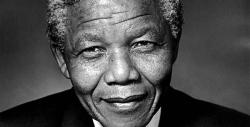
Nelson Mandela: “After becoming president, I once asked some members of my close protection to walk with me around the city, to have lunch in one of its restaurants.
We sat in one of the restaurants in the city centre and all asked for food.”
“After a while the waiter brought us our requests, I noticed that there is someone sitting in front of my table waiting for food”
I then said to one of the soldiers: go ask this person to join us with his food and eat with us.
The soldier went to ask the man. The man brought his food and sat next to me while I asked him and started eating.
His hands were constantly shaking until everyone finished their meal and the man left.
The soldier said to me: The man was apparently very ill. His hands were shaking while he ate!”
“No, not at all,” Mandela said.
“This man was the guard of the prison where I was imprisoned. “Often, after the torture I suffered, I would scream and ask for some water.
“The same man would come every time and urinated on my head. “ “So I found him frightened, trembling, expecting me to reciprocate, at least in the same way, either by torturing him or by imprisoning him as I am now the President of the State of South Africa.”
“But that’s not my character or part of my ethic.”
“The mentality of reprisals destroys states, while the mentality of tolerance builds nations.”
Celebrated organizational psychologist and author Adam Grant provides compelling insight into why we should spend time not just thinking, but rethinking. In this episode we cover how to change our own views, how to change the views of others, hiring processes, psychological safety, tribes and group identity, feigned knowledge, binary bias, and so much more.
Grant is a Professor of Psychology at The Wharton School of the University of Pennsylvania and the author of five books, including his most recent release, the New York Times bestseller Think Again. He also serves as the host of WorkLife, a TED original podcast.
Sri Ramana Maharshi – Venkataraman Iyer. Born – December 30, 1879, India Died – April 14, 1950. Tamil Nadu, South India.
Sri Ramana Maharshi said, ‘then you go elsewhere, because here we teach unlearning. Learning is not our way. You go elsewhere. If you are ready to unlearn, be here. If you have come to learn more, then this is not the right place. Then go somewhere else – universities exist for learning. When you come to me, come to unlearn. This is a university for unlearning, university to create no-mind, a university where whatsoever you know will be taken away.All your knowledge has to be dropped so that you become knowing, so you get a perfection, a clarity, so that your eyes are not filled with theses, or theories, with prejudices, concepts; so your eyes have a clarity, an absolute clarity and transparency, so that you can see. The truth is already there. It has always been there.“`
A new consciousness and a totally new morality are necessary to bring about a radical change in the present culture and social structure. This is obvious, yet the Left and the Right and the revolutionary seem to disregard it. Any dogma, any formula, any ideology is part of the old consciousness; they are the fabrications of thought whose activity is fragmentation – the Left, the Right, the centre. This activity will inevitably lead to bloodshed of the Right or of the Left or to totalitarianism. This is what is going on around us. One sees the necessity of social, economic, and moral change but the response is from the old consciousness, thought being the principal actor. The mess, the confusion, and the misery that human beings have got into are within the area of the old consciousness, and without changing that profoundly,every human activity – political, economic or religious – will only bring us to the destruction of each other and of the earth. This is so obvious to the sane.
Renowned researcher and author Jim Collins makes his second appearance on The Knowledge Project, this time to share a wealth of life lessons learned from his mentor and collaborator, Bill Lazier. Jim recently released BE 2.0 (Beyond Entrepreneurship 2.0), an ambitious upgrade of his first book Beyond Entrepreneurship, co-authored with Lazier and focused on effective leadership style. Shane discusses all new topics with Jim in their follow-up conversation, including what it means to be a mentor and a father, why we should trust by default, why we confuse living a long life with a great life, and the difference between being afraid of risk and being afraid of ambiguity.
Lao Tzu used to say that in a storm big trees stand rigidly and so they are uprooted. Small plants bend with the winds ; the storm blows over them . The roots of big trees are overturned , they laid flat on the ground; but small plants stand as straight as they did before. The storm gives new life to the plants, but it destroys the trees which are stubborn and proud. It is the same storm ! The weak are saved and the mighty are destroyed……..
……What we call strength in the language of this world is weakness in the language of spirituality. And that which we call weakness in the language of this world is strength in the language of spirituality. To bow down is weakness in this world : “Come what may , do not bow down to anything”. In the language of spirituality, bowing down is an invitation for the energy of strength to fill you.
And one who bows down is filled from all sides: energy from the whole universe starts flowing towards him. He becomes like a vessel . His invitation is heard everywhere.
Elon Musk’s entrepreneurial success is a direct result of his mindset, strategies, and intelligence.
Having known Elon for 20 years, I’ve had the opportunity to watch his meteoric rise into someone who is arguably the greatest entrepreneur of our age.
In this blog, I’ll summarize what every exponential entrepreneur can learn and emulate from Elon’s core success tactics and strategies.
I’ve divided these lessons into 6 sections:
Deep-rooted Passion
Massively Transformative Purpose
Singular, Unwavering Focus
First Principles Thinking
Thinking in Probabilities
Not Settling for “No” / Not Giving Up
Let’s dive in…
1. DEEP-ROOTED PASSION
“I didn’t go into the rocket business, the car business, or the solar business thinking, ‘This is a great opportunity.’ I just thought, in order to make a difference, something needed to be done. I wanted to create something substantially better than what came before.” – Elon Musk
Elon only tackles those problems where he has deep-rooted passion and conviction.
After selling PayPal, with $165M in his pocket, he set out to pursue three Moonshots, and subsequently built three multibillion-dollar companies: SpaceX, Tesla, and SolarCity.
This passion (and the underlying emotional drive) allowed him to push forward through extraordinarily difficult times and take big risks.
You might think it was always easy for Elon, but back in 2008 he was at a lowest low: SpaceX had just experienced its third consecutive failure of the Falcon-1 launch vehicle, Tesla was out of money, SolarCity was not getting financed, and Musk was going through a divorce.
He had to borrow money for basic living. Traumatic times.
Despite the 2008 economic crisis at the time, he bet every penny he had, and eventually everything turned around. Going from being in debt, to the wealthiest person on the planet just 13 years later. Wow, what a journey!
Ultimately, it was his passion, refusal to give up, and drive that allowed him to ultimately succeed and begin to impact the world at a significant scale.
2. CLEAR MASSIVELY TRANSFORMATIVE PURPOSE(S)
Part of Elon’s ability to motivate his teams to do great things is his crystal-clear Massively Transformative Purpose (MTP), which drives each of his companies.
As I always say, social movements, rapidly growing organizations, and remarkable breakthroughs in science and technology are all backed by a powerful MTP.
Elon’s MTP for Tesla and SolarCity is to accelerate the world’s transition to sustainable energy.
To this end, every product Tesla brings to market is focused on this vision and backed by a Master Plan he wrote nearly 15 years ago.
Elon’s MTP for SpaceX is to backup the biosphere by making humanity a multi-planet species.
Elon has been preaching this since the founding of SpaceX back in 2002, even when he was experiencing numerous rocket failures.
“I think fundamentally the future is vastly more exciting and interesting if we’re a spacefaring civilization and a multi-planet species than if we’re or not. You want to be inspired by things. You want to wake up in the morning and think the future is going to be great. And that’s what being a spacefaring civilization is all about.” – Elon Musk
MTPs are like a north star for any exponential entrepreneur and their employees.
They keep all efforts focused and aligned, which helps his organizations grow cohesively even in times of chaos.
And when you combine passion and purpose, that gives you something else…
3. SINGULAR, UNWAVERING FOCUS
Elon is notorious for working 75 – 80 hour weeks, especially in the early days of SpaceX and Tesla.
There were times during Tesla’s early days where a specific problem needed to be solved, so he would sleep under his desk or on the factory floor if he had to. Elon didn’t think about anything else—all he focused on was the task at hand.
And now look at Tesla: it’s a giant transforming the automotive world.
Passion, purpose, and focus. All of these put you into what psychologists call a flow state: a highly enjoyable and meaningful state where work ceases to become work and instead becomes energizing and immersive.
This intensity that Elon brings is different from the kind of intensity that burns people out or causes them to quit jobs. For him, the intensity is energizing—not draining.
4. FIRST PRINCIPLES THINKING
First principles thinking is a mode of inquiry borrowed from physics that is designed to relentlessly pursue the foundations of any given problem from fundamental truths.
Elon has deployed this thinking strategy to give himself an unfair advantage when developing new batteries, a key component for both Tesla and SolarCity.
Here is Elon describing first principles thinking in an interview with Kevin Rose:
“I think it is important to reason from first principles rather than by analogy. The normal way we conduct our lives is we reason by analogy. [When reasoning by analogy] we are doing this because it’s like something else that was done or it is like what other people are doing — slight iterations on a theme.
First principles is kind of a physics way of looking at the world. You boil things down to the most fundamental truths and say, “What are we sure is true?” … and then reason up from there.
Somebody could say, “Battery packs are really expensive and that’s just the way they will always be… Historically, it has cost $600 per kilowatt hour. It’s not going to be much better than that in the future.”
With first principles, you say, “What are the material constituents of the batteries? What is the stock market value of the material constituents?”
It’s got cobalt, nickel, aluminum, carbon, some polymers for separation and a sealed can. Break that down on a material basis and say, “If we bought that on the London Metal Exchange what would each of those things cost?”
It’s like $80 per kilowatt hour. So clearly you just need to think of clever ways to take those materials and combine them into the shape of a battery cell and you can have batteries that are much, much cheaper than anyone realizes.”
First principles thinking works so well because it gives us a proven strategy for editing out complexity and allows entrepreneurs to sidestep the tide of popular opinion.
Now, you might be wondering, “How do you motivate people with brutal facts? Doesn’t motivation flow chiefly from a compelling vision?” The answer, surprisingly, is, “No.” Not because vision is unimportant, but because expending energy trying to motivate people is largely a waste of time. One of the dominant themes that runs throughout this book is that if you successfully implement its findings, you will not need to spend time and energy “motivating” people. If you have the right people on the bus, they will be self-motivated. The real question then becomes: How do you manage in such a way as not to de-motivate people?And one of the single most de-motivating actions you can take is to hold out false hopes, soon to be swept away by events.
Yes, leadership is about vision. But leadership is equally about creating a climate where the truth is heard and the brutal facts confronted. There’s a huge difference between the opportunity to “have your say” and the opportunity to be heard. The good-to-great leaders understood this distinction, creating a culture wherein people had a tremendous opportunity to be heard and, ultimately, for the truth to be heard.
A bold, urgent argument on the misplacement of value in financial markets and how we can and need to maximize value for the many, not few.
As an economist and former banker, Mark Carney has spent his life in various financial roles, in both the public and private sector. VALUE(S) is a meditation on his experiences that examines the short-comings and challenges of the market in the past decade which he argues has led to rampant, public distrust and the need for radical change. Focusing on four major crises-the Global Financial Crisis, the Global Health Crisis, Climate Change and the 4th Industrial Revolution– Carney proposes responses to each. His solutions are tangible action plans for leaders, companies and countries to transform the value of the market back into the value of humanity.
It starts by standing with the poor, listening to voices unheard, and recognizing potential where others see despair.
It demands investing as a means, not an end, daring to go where markets have failed and aid has fallen short. It makes capital work for us, not control us.
It thrives on moral imagination: the humility to see the world as it is, and the audacity to imagine the world as it could be. It’s having the ambition to learn at the edge, the wisdom to admit failure, and the courage to start again.
It requires patience and kindness, resilience and grit: a hard-edged hope. It’s leadership that rejects complacency, breaks through bureaucracy, and challenges corruption. Doing what’s right, not what’s easy.
it’s the radical idea of creating hope in a cynical world. Changing the way the world tackles poverty and building a world based on dignity.Continue reading →


 ONE TUSK