Ordinarily, we are walking bundles of solutions to problems that no longer exist. Everybody is so. You are carrying thousands of solutions for problems which are no more existent – and you call it knowledge. It is hindering your capacity to know. It is not knowledge.
Drop all the solutions that you are carrying. Drop all the answers that you are carrying. Just remain silent. And whenever a question arises, out of that silence you will hear the answer – and that will be THE answer. It will not come from you, it will not come from scriptures, it will not come from anywhere – it will come from nowhere and it will come from nobody. It will come from your innermost nothingness.
The more deeply a thought or action is tied to your identity, the more difficult it is to change it…… The biggest barrier to positive change at any level—individual, team, society—is identity conflict. Good habits can make rational sense, but if they conflict with your identity, you will fail to put them into action….
Over the long run, however, the real reason you fail to stick with habits is that your self-image gets in the way. This is why you can’t get too attached to one version of your identity. Progress requires unlearning. Becoming the best version of yourself requires you to continuously edit your beliefs, and to upgrade and expand your identity.
You’re actually above the other only in your own idealization of your own behavior. You are not above them, they are not below you. They are having a different encounter with themselves, and perhaps learning through it, and perhaps giving you the opportunity to learn as well. If you assume that someone is not where they are supposed to be, you have decided for them based upon what you think they should be, or perhaps where or how they should behave based upon your idealisation of behaviour…..
This does not make them wrong. Do you understand this? It doesn’t make you wrong, either, but it certainly doesn’t make you right……
If you can understand that everyone has come to learn—how they learn their lessons is in some ways decided by them at a higher level—you learn not to judge.
You don’t have to enable, you don’t have to agree….
An investment banker and professor explains what really drives success in the tech economy
Many think that they understand the secrets to the success of the biggest tech companies: Facebook, Amazon, Apple, Netflix, and Google. It’s the platform economy, or network effects, or some other magical power that makes their ultimate world domination inevitable. Investment banker and professor Jonathan Knee argues that the truth is much more complicated–but entrepreneurs and investors can understand what makes the giants work, and learn the keys to lasting success in the digital economy.
Knee explains what really makes the biggest tech companies work: a surprisingly disparate portfolio of structural advantages buttressed by shrewd acquisitions, strong management, lax regulation, and often, encouraging the myth that they are invincible to discourage competitors. By offering fresh insights into the true sources of strength and very real vulnerabilities of these companies, The Platform Delusion shows how investors, existing businesses, and startups might value them, compete with them, and imitate them.
The Platform Delusion demystifies the success of the biggest digital companies in sectors from retail to media to software to hardware, offering readers what those companies don’t want everyone else to know. Knee’s insights are invaluable for entrepreneurs and investors in digital businesses seeking to understand what drives resilience and profitability for the long term.
Try it. Live for one day, one hour, as though you were going to die, actually going to die the next hour.
If you knew you were about to die, what would you do? You would gather your family together, put your money and property in order, and draw up a will. Then, as death approached, you would have to understand all that you had been. If you were merely frightened because you were dying, you would be dying for nothing. But you would not be frightened if you said, ‘I have lived a dull, ambitious, envious, stupid life, and now I am going to wipe all that totally from my memory. I am going to forget the past and live in this hour completely.
If you can live one hour as completely as that, you can live completely for the rest of your life.
But to die is hard work – not to die through disease and old age, that is not hard work at all. That is inevitable, it is what we are all going to do, and you cushion yourself against it in innumerable ways. But if you die so that you are living fully in this hour, you will find there is an enormous vitality, a tremendous attention to everything because this is the only hour you are living.
You look at this spring of life because you will never see it again; you see the smile, the tears, you feel the earth, you feel the quality of a tree, you feel the love that has no continuity and no object. Then you will find that in this total attention the ‘me’ is not, and that the mind, being empty, can renew itself. Then the mind is fresh, innocent, and such a mind lives eternally beyond time.
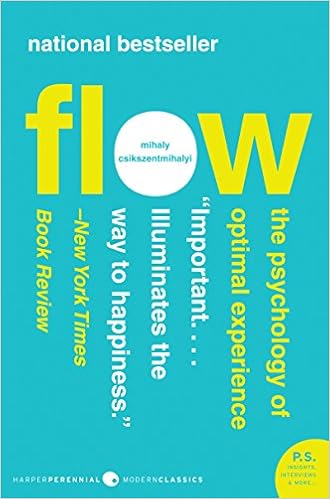
Psychologist Mihaly Csikszentmihalyi’s famous investigations of “optimal experience” have revealed that what makes an experience genuinely satisfying is a state of consciousness called flow. During flow, people typically experience deep enjoyment, creativity, and a total involvement with life. In this new edition of his groundbreaking classic work, Csikszentmihalyi demonstrates the ways this positive state can be controlled, not just left to chance. Flow: The Psychology of Optimal Experience teaches how, by ordering the information that enters our consciousness, we can discover true happiness and greatly improve the quality of our lives.
Do you think a leaf that falls to the ground is afraid of death? Do you think a bird lives in fear of dying? It meets death when death comes; but it is not concerned about death, it is much too occupied with living, with catching insects, building a nest, singing a song, flying for the very joy of flying. Have you ever watched birds soaring high up in the air without a beat of their wings, being carried along by the wind? How endlessly they seem to enjoy themselves! They are not concerned about death. If death comes, it is all right, they are finished. There is no concern about what is going to happen; they are living from moment to moment, are they not? It is we human beings who are always concerned about death – because we are not living. That is the trouble: we are dying, we are not living.
Notes to Myself is one of MOPA’s flagship projects – a series of interactive, expository documentaries that deconstructs the lives and creative processes of some of the most impactful professionals associated with South India’s performing arts. Done in a let-your-hair-down and from-the-heart way, these offer an honest, moving and at times funny and charmingly unguarded look at the lives of these artistes.
This is the voice of Bombay Jayashri, a singer who has performed widely and successfully across genres – Carnatic music, Indian film playback singing, semi-classical music, fusion and more.



![The Platform Delusion: Who Wins and Who Loses in the Age of Tech Titans by [Jonathan A. Knee]](https://m.media-amazon.com/images/I/41QFzYc7l6S.jpg)



 ONE TUSK