Author: onetusk
There is a place called, “beyond hope and fear”

What if, at the end of our lives, we die having watched destruction and not been able to create any good effect?
What, really, is available to us if we can’t save the world? What do we fund our work for? Where do we gain energy if we don’t believe that we’re going to be successful? How can we do our work without hope that we will succeed?
View original post 392 more words
Thought for the Week – 2nd July 2018

Every Feeling is a Field of Energy
 Because emotions emit a vibrational energy field, they affect and determine the people who are in our lives. Life events become influenced by our repressed and suppressed emotions on the psychic level. Thus anger attracts angry thoughts. The basic rule of the psychic universe is that “like attracts like.” Similarly, “love promotes love,” so that the person who has let go of a lot of inner negativity is surrounded by loving thoughts, loving events, loving people, and loving pets.
Learning to Grow Up
 Organizations have been built on the notion that people must be held accountable and that someone else is in charge of doing that. This kind of thinking, more than anything else, creates and maintains parent–child conversations in the workplace that foster cultures relying on compliance rather than commitment. The idea that we are all responsible for our own commitment is radical.
Thought for the Week – 25th June 2018

Book Recommendation : Radical Candor by Kim Scott
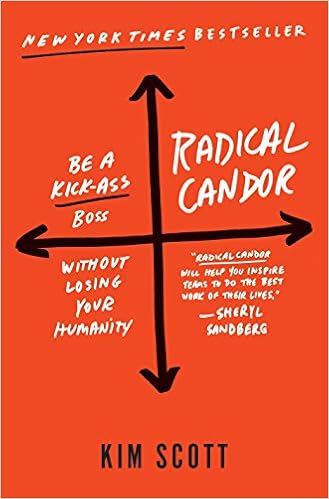 From the time we learn to speak, we’re told that if you don’t have anything nice to say, don’t say anything at all. When you become a manager, it’s your job to say it–and your obligation.
Author Kim Scott was an executive at Google and then at Apple, where she worked with a team to develop a class on how to be a good boss. She has earned growing fame in recent years with her vital new approach to effective management, Radical Candor.
Radical Candor is a simple idea: to be a good boss, you have to Care Personally at the same time that you Challenge Directly. When you challenge without caring it’s obnoxious aggression; when you care without challenging it’s ruinous empathy. When you do neither it’s manipulative insincerity.
This simple framework can help you build better relationships at work, and fulfill your three key responsibilities as a leader: creating a culture of feedback (praise and criticism), building a cohesive team, and achieving results you’re all proud of.
Radical Candor offers a guide to those bewildered or exhausted by management, written for bosses and those who manage bosses. Taken from years of the author’s experience, and distilled clearly giving actionable lessons to the reader; it shows managers how to be successful while retaining their humanity, finding meaning in their job, and creating an environment where people both love their work and their colleagues.
( Recommended by Fanny Limare-Wolf) Continue reading
Thought for the week – 18th June 2018
“When we are concerned with the well-being of other human beings, that inner door opens, and we are able to communicate very easily with other people”
– Archbishop Tutu
Radical Candor: Care Personally at the same time that you Challenge Directly
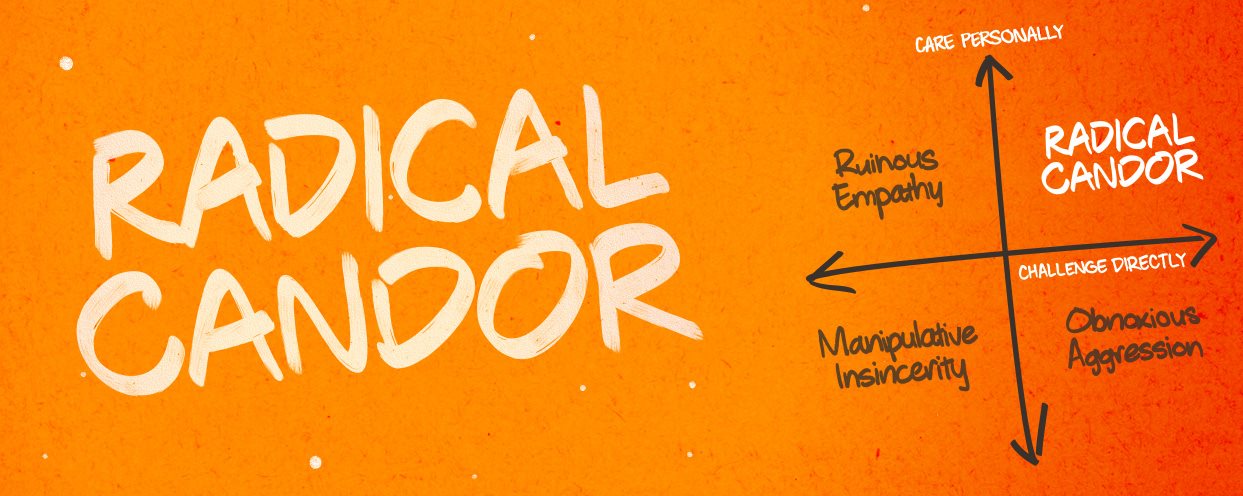
Radical Candor is a simple idea:
To be a good leader, you have to Care Personally at the same time that you Challenge Directly.
When you challenge without caring it’s obnoxious aggression;
When you care without challenging it’s ruinous empathy.
When you do neither it’s manipulative insincerity.
![Radical Candor: Be a Kick-Ass Boss Without Losing Your Humanity by [Scott, Kim]](https://images-na.ssl-images-amazon.com/images/I/411O8D1w2UL.jpg)
(Book Recommended by Fanny L-W)
In the new economy, management and leadership are not easily separated
 In his 1989 book “On Becoming a Leader,” Warren Bennis composed a list of the differences between managers and leaders:
– The manager administers; the leader innovates.
– The manager is a copy; the leader is an original.
– The manager maintains; the leader develops.
– The manager focuses on systems and structure; the leader focuses on people.
– The manager relies on control; the leader inspires trust.
– The manager has a short-range view; the leader has a long-range perspective.
– The manager asks how and when; the leader asks what and why.
– The manager has his or her eye always on the bottom line; the leader’s eye is on the horizon.
– The manager imitates; the leader originates.
– The manager accepts the status quo; the leader challenges it.
– The manager is the classic good soldier; the leader is his or her own person.
– The manager does things right; the leader does the right thing. Continue reading
 ONE TUSK