A Neighbour , a Pilgrim, a Pope:
In memory of Pope Francis (1936–2025)
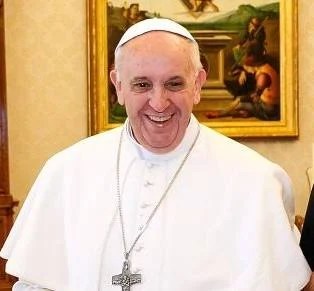
Today, the world bids farewell to a gentle giant of spirit.
Pope Francis—the first non-European, Latin American, and Jesuit Pope in the history of the Church—has left this world. His departure, so soon after the sacred silence of Holy Week, feels like the soft closing of a holy chapter.
As a fellow pilgrim born in Buenos Aires, I cannot help but feel this loss in a personal way. As a child, he lived only a few blocks from where I grew up. We were neighbors—one generation apart.
We even supported the same football team: San Lorenzo. Something as simple as that makes the memory even warmer—two believers, two neighbors, two hinchas sharing a thread of belonging beyond doctrine.
And though we never met, I have long considered him kindred.
While I walk the path of Gaudiya Vaishnavism, I do not feel this in opposition to the spirit of Christianity. In fact, I often say—truthfully and openly—that, in essence, I consider myself a Christian too. How could I not be touched by the life and teachings of Jesus, the wounded healer, the teacher who knelt, the lover who loved unto death?
Today, as I write these words, our ashram in North Carolina welcomes a dear friend: Father Cassian, a Catholic priest and monk, who will stay with us for some time. His presence feels especially poignant today, as we mourn and honor one of the most transformative figures in recent Christian history.
Pope Francis dared to break boundaries—geographical, social, and theological. He championed the poor with tenderness and ferocity. He called for an integral ecology, where care for creation is inseparable from care for the vulnerable. His encyclicals Laudato Si’ and Fratelli Tutti were not merely Catholic texts, but universal appeals to conscience, reminding us that the Earth is not only our common home—it is sacred.
He reached toward those whom others overlooked: the divorced, the queer, the imprisoned, the forgotten. He believed that no one stands outside the circle of God’s mercy. And though his efforts were often misunderstood—by conservatives and progressives alike—he kept walking, one foot in the Gospel, the other in the dirt of our time.
He simplified the papacy. He renounced palatial opulence. He cooked his own meals. He asked us to pray for him, always. And he wept when he spoke of war, refugees, or ecological collapse—not as a politician, but as a father. As a brother of humanity.
Of course, like all great souls, he was not without controversy. While I may not agree with every statement he made or stance he took, I firmly believe in honoring the whole of a life, not its isolated parts. I believe in seeing people not merely for their past, nor even their present, but for their luminous future in God’s grace.
To my Christian brothers and sisters: my heart is with you. This is a sacred day of mourning, of reflection, and also of thanksgiving—for a life that mirrored the Beatitudes more than the headlines. May the same Spirit that breathed through him breathe now into your hearts, offering comfort and conviction.
And to those in my own bhakti community: may we dare to learn from such lives. May we embody that same courage to stand with the marginalized, to speak for the voiceless, to see the sacred in soil and in stranger. May we remember that true religion is not performance, but love in action.
Rest well, dear neighbor.
Rest well, holy pilgrim.
Your feet have kissed many roads—and now they’ve returned Home.
🙏- Swami Padmanabha
 ONE TUSK